








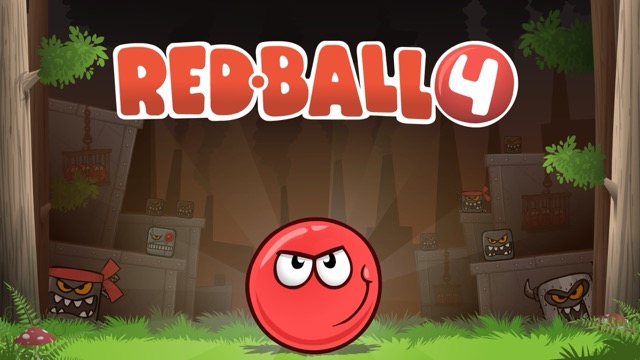
Red Ball 4
Red Ball 4 is a charming physics-based platformer that pits a determined red ball against an army of evil squares with a singular, alarming goal: to turn the entire kingdom into a square. Your job is to stop them — rolling, jumping, and bouncing through 75 levels spread across four distinct worlds: grasslands, forests, factories, and a dramatic finale on the moon. It's a game with personality, purpose, and a platformer challenge that deepens meaningfully as the world count grows.
The game's central appeal is in its physics. The red ball rolls and bounces with genuine weight, and the levels are built around that physical reality: ramps launch you to distant platforms, floating boxes provide stepping stones across water sections (the red ball absolutely cannot swim), and environmental geometry creates puzzle-like navigation challenges that pure jump-and-run games don't produce. Enemies are an active threat that must be jumped on to defeat — not avoided around — adding a combat rhythm to the platforming challenge.
What makes Red Ball 4 genuinely replayable is the star collection system. Each of the 75 levels contains three collectible stars, most of which require deliberate routing decisions or brave deviations from the safest path to reach. Completing a level is the minimum — collecting all three stars is the achievement that separates a thorough playthrough from a complete one. Add enemy bosses at world boundaries, an escalating variety of platform types and obstacles across four world themes, and a progression that introduces new mechanics without overwhelming new players, and Red Ball 4 earns its place as one of the most beloved browser platformers ever made.
Key Details:
| Field | Info |
|---|---|
| Genre | Physics Platformer / Action Adventure |
| Difficulty Level | Variable (Easy early levels to Challenging in factory and moon worlds) |
| Average Play Time | 5–20 minutes per session |
| Best For | All ages, platformer fans, physics game enthusiasts, completionists |
How to Play Red Ball 4?
Getting Started:
- Select the first level of the grassland world — early levels introduce rolling, jumping, and basic enemy encounters.
- Roll left and right with the arrow keys or A/D to build momentum across the terrain.
- Jump with the Up Arrow, W, or Spacebar to clear gaps, reach higher platforms, and land on enemies.
- Use ramps to reach distant or elevated platforms that direct jumping can't access.
- Collect all three stars in each level for full completion — stars are positioned to reward exploration beyond the direct route to the exit.
Basic Controls:
| Key | Action |
|---|---|
← / A | Roll left |
→ / D | Roll right |
↑ / W / Space | Jump |
Objective: Roll the red ball through all 75 levels across four worlds without falling into pits or being defeated by enemies. Defeat enemies by jumping on them from above. Cross water sections using stepping stones, floating boxes, and environmental objects — the red ball cannot swim. Collect all three stars in each level for complete mastery. Reach and defeat the boss at the end of each world to advance.
Red Ball 4 Features & Highlights
✓ 75 levels across four distinct worlds — Grasslands, forests, factories, and the moon each offer unique visual environments, obstacle types, and platform configurations that keep the game visually and mechanically varied throughout.
✓ Three-star collection system — Each level contains three collectible stars that require exploration and routing decisions beyond the direct path to the exit, rewarding completionist play.
✓ Physics-based rolling and jumping — Authentic weight and momentum in the red ball's movement create a platforming feel distinct from precision platformers, rewarding players who understand and use the ball's physical properties.
✓ Enemy combat via jumping — Evil square enemies must be defeated by landing on them from above — adding an active combat objective to the traversal and platforming challenge.
✓ Environmental puzzle elements — Water crossings using stepping stones and floating boxes, ramps for reaching distant platforms, and interactive environment objects create light puzzle-solving within the platformer format.
Red Ball 4 Tips & Strategies
Beginner Tips:
- Build momentum before ramps, not during them. Ramps are most effective when the ball arrives at them with rolling speed already established. A ball that reaches a ramp slowly produces a short, low arc; one that arrives at speed launches further and higher. Identify ramps ahead and roll toward them with full momentum before the launch.
- Jump on enemies from above — never approach them from the side. Side contact with an evil square enemy costs a life. The only safe interaction is landing directly on top of one. If an enemy is between you and the exit, either clear it with a precise top-down jump or find an alternate route around it at a height that avoids contact.
- In water sections, plan your stepping stone route before moving. Water is instantly lethal to the red ball, and stepping stones and floating boxes have limited surface area. Plan the full crossing route visually before committing to the first step — a mid-water reassessment with nowhere safe to pause is the most common cause of water section deaths.
Advanced Strategies:
- Use the ball's bounce after falling to reach star positions that seem too high. The red ball bounces slightly on impact with solid surfaces. In some levels, a controlled fall from a moderate height produces enough bounce to reach a star platform that would be inaccessible by direct jump. Experiment with fall-bounce combinations in levels where stars appear just out of standard jump reach.
- Collect stars on a separate routing pass after confirming the exit route. In complex levels, attempting to collect all three stars on your first completion run risks losing the run on a star-collection detour. On first attempts, identify the star positions and exit route simultaneously — then collect stars on your second run with complete level knowledge.
- In factory and moon levels, use the environment's momentum hazards to your advantage. Later worlds introduce moving platforms, mechanical hazards, and environmental forces that push or pull the ball. Understanding the direction and timing of these forces — and using them to carry the ball to positions that direct rolling can't reach — is the key skill advanced players develop in these worlds.
What to Watch Out For:
- Platform edges in factory levels that are narrower than they appear. Factory world platforms are frequently industrial surfaces with edges that the camera angle can make look more forgiving than they are. When landing on factory platforms — particularly after a ramp launch — account for the ball's bounce and ensure there's enough surface ahead to absorb it without rolling off the far edge.
- Enemy placement near gap edges. Some enemy configurations place evil squares immediately adjacent to pit edges, where the natural impulse to jump away from the enemy carries the ball off the edge rather than to safety. Identify enemies near edges before approaching and plan a jump angle that clears the enemy from above rather than laterally.
Red Ball 4 Elements Explained
Four-World Structure & Level Design
Red Ball 4's four-world structure — grasslands, forests, factories, and the moon — provides distinct visual and mechanical environments that keep the 75-level roster from feeling repetitive. Each world introduces new obstacle types and environmental hazards specific to its theme, meaning that the skills required to clear the grassland world are necessary but insufficient for the factory world's mechanical platform challenges.
The grasslands serve as the game's tutorial environment: open terrain, visible enemies, and simple gap structures that introduce rolling momentum, basic jumping, and enemy-jumping combat without combining them into complex sequences. The forest world adds denser obstacle configurations, elevated platform challenges, and water crossings that introduce the stepping stone navigation the red ball's swimming inability creates. The factory world is the game's mid-point difficulty escalation: industrial machinery, moving platforms, mechanical hazards, and environments where the ball's physics interact with moving elements in ways the earlier worlds don't require. The moon world, as the campaign's finale, combines the mechanical complexity of the factory world with reduced-gravity physics that change the ball's jump arc and landing behaviour.
This world-by-world escalation means that players who work through the campaign sequentially arrive at each new world having developed the specific skills that world will demand most — a progressive difficulty curve that feels earned rather than arbitrarily imposed.
Star Collection System
The star collection system is Red Ball 4's primary completionist mechanic and the feature most responsible for extending the game's replayability beyond simple level completion. Each of the 75 levels contains three gold stars placed at specific positions — some on the direct route to the exit, many requiring deliberate routing detours to reach. Collecting all three stars in a level marks it as fully completed, distinct from the basic completion of simply reaching the exit.
Star placement is designed to reward exploration and physical courage. Stars positioned on elevated platforms require confident ramp launches or precise bounce exploitation. Stars near enemy positions require controlled enemy encounters rather than avoidance. Stars adjacent to pit edges or water boundaries require deliberate navigation to risky positions rather than conservative centre-track routing. This placement philosophy means that a player who collects all three stars in every level has demonstrated meaningfully more comprehensive skill than one who completes levels with zero-star passes.
The three-star system also provides a clear metric for returning to completed levels. A player who finishes a level with only one or two stars has an explicit, concrete goal for a replay — not a vague aim to "do better" but specific missing stars with known positions to collect. This transforms completed levels from finished content into recurring opportunities with defined objectives.
Enemy & Boss System
Red Ball 4's enemy system is built around the evil square adversaries that populate each world with increasing density across the four world progression. Evil squares move in patrol patterns and occupy platform positions that the red ball must clear to progress. The mechanics of enemy interaction are simple and consistent: landing on an enemy from above destroys it; touching one from the side costs a life. This simplicity produces a clear, readable combat dynamic that new players understand within seconds.
The boss encounters at the end of each world scale this combat dynamic into extended battles that test the skills the preceding world developed. Each boss is themed to its world and requires a specific approach to defeat — a sequence of hits delivered under specific conditions while the boss deploys hazards and attacks that must be dodged simultaneously. Boss encounters are among the most demanding sections of their respective worlds and provide satisfying climactic challenges before each world transition.
The combination of patrol-pattern regular enemies and structured boss fights gives Red Ball 4 a combat rhythm absent from most rolling ball games, and it's this rhythm — the planning of enemy approaches, the timing of overhead jumps, the reading of boss attack patterns — that gives the game its personality beyond the physics platformer mechanics.
Red Ball 4 Frequently Asked Questions
Q: How do I cross water sections? The red ball can't swim. A: Use stepping stones, floating boxes, and other environmental objects as platforms to cross water without making contact with it. Look for these objects at or near water boundaries before attempting a crossing — they provide the only safe traversal path over water sections. Plan the full stepping stone route visually before committing to the first step, as mid-crossing hesitation with limited safe surfaces available almost always results in a fatal fall into the water.
Q: How do I defeat enemies without getting hurt? A: Jump directly onto an enemy from above — the ball must make contact with the top surface of the enemy to defeat it safely. Lateral contact from the side ends in the red ball losing a life. Approach enemies from a position directly above them and fall or jump with enough vertical momentum to land on the top. If a direct top-down approach isn't possible, find an alternate route around the enemy until you can reach a position above it.
Q: What is the most effective way to collect all three stars in each level? A: On first completion attempts, focus on identifying star positions and the safest route to each one without compromising the exit route. On second attempts — with full level knowledge — run the optimal star collection path that routes through all three positions efficiently. Trying to collect all three stars and complete the level simultaneously on a first attempt increases risk significantly; the star routing and exit routing are easier to execute separately with complete level knowledge on hand.
Q: How do I use ramps effectively? A: Approach ramps at full rolling speed by building momentum before reaching them — a slow approach produces a weak, short launch, while a fast approach produces a longer arc that reaches distant platforms. Control your landing trajectory by adjusting roll direction mid-air after launch. In levels where a ramp is the only path to a star or elevated section, try multiple approach speeds to find the momentum that produces the correct arc for that specific ramp and target.
Q: Does Red Ball 4 get significantly harder in later worlds? A: Yes — the factory and moon worlds are meaningfully harder than the grassland and forest worlds. Factory levels introduce mechanical moving platforms, industrial hazards, and confined spaces that require more precise rolling and jumping than the open terrain of earlier worlds. The moon world changes the ball's physics with reduced gravity, altering jump arc and landing distance in ways that require recalibration of every movement expectation the earlier worlds established. Both later worlds are designed as genuine challenges for players who have mastered the earlier content.