





















Slope Ball
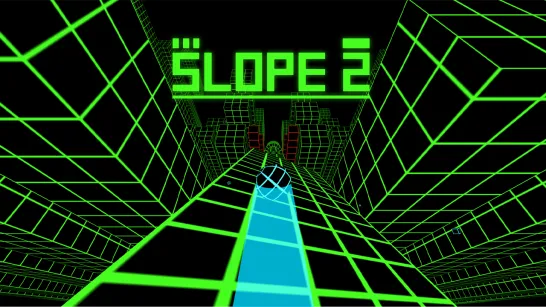
Slope Ball is a rhythm-based action platformer that takes the Slope name in a wildly different direction — and it's better for it. Forget the endless runner formula. Here, you're navigating carefully designed levels packed with spikes, moving traps, floating platforms, and colour-shifting portals that transform your character mid-run. One moment you're a rolling ball; the next, a flying ship, a diagonal wave, or a double-jumping robot. Mastering every form is the game's central challenge and its greatest source of satisfaction.
The world of Slope Ball is genuinely cinematic in scale. Spread across five distinct locations and eleven thrilling laps, the game sends you on a mission to save five legendary prehistoric creatures — the T-Rex Tyrannosaurus, the Titanoboa, the Quetzalcoatlus, the Megatherium, and the Megalodon — each guarded by a boss encounter that tests everything you've learned in the levels before it. It's a structure that gives each run a sense of purpose and narrative weight that the endless runner format simply can't provide.
The game also boasts a thriving creator community. A built-in level editor lets players design and share their own stages, and thousands of user-generated levels are available to play alongside the main campaign. Add unlockable character icons, customisable colours, checkpoint-based restarts that keep frustration low, and collectible stars that reward thorough exploration of every level — and you have the most content-rich and creatively layered game in the entire Slope series.
Key Details:
| Field | Info |
|---|---|
| Genre | Rhythm Platformer / Action Arcade |
| Difficulty Level | Variable (increases across levels and boss encounters) |
| Average Play Time | 10–30 minutes per session |
| Best For | Platformer fans, Geometry Dash players, creative and completionist players |
How to Play Slope Ball?
Getting Started:
- Select a level from the five-location world map to begin.
- The ball moves automatically — your only job is to control jumps and timing.
- Press the jump button before reaching an obstacle; let your character fall naturally when hazards appear below.
- Pass through coloured portals to transform your character and adapt to each new form's movement style.
- Collect all three stars in a level and reach the glowing wall at the end to complete it gloriously.
Basic Controls:
| Input | Action |
|---|---|
Space, ↑ Up Arrow, or Left Mouse Button | Jump / Fly |
| Use items marked with an arrow icon | Interact |
| Avoid items marked with an X | Do not interact — instant failure |
Objective: Guide your character through each level's obstacles, portals, and traps to reach the glowing end wall. Collect all three stars hidden in each lap for a complete victory. At the end of each world, defeat the boss creature guarding that location. Checkpoints throughout the levels mean a collision restarts you at the last checkpoint reached — not the very beginning — so persistence always pays off.
Slope Ball Features & Highlights
✓ Shape-shifting character system — Portals transform you into a cube, flying ship, wave, or double-jumping robot mid-level, each with entirely different movement physics that must be mastered on the fly.
✓ Five worlds and eleven laps — A structured campaign across five distinct locations, each with its own visual theme, background music, and a legendary prehistoric boss creature to defeat.
✓ User-generated level ecosystem — A built-in level editor lets you design and publish your own stages, with thousands of community-created levels already available to explore beyond the main campaign.
✓ Three-star collection system — Each level hides three collectible stars, rewarding thorough play and giving completionists a concrete reason to replay levels they've already cleared.
✓ Unlockable icons and colours — Customise your character's appearance with a growing selection of unlockable skins and colour schemes earned through gameplay progress.
Slope Ball Tips & Strategies
Beginner Tips:
- Learn each transformation before committing to a difficult section. Every form — cube, ship, wave, robot — jumps and moves differently. When a portal changes your form, take a mental breath and adjust your inputs before the next obstacle arrives.
- Use checkpoints as learning resets, not failures. Slope Ball is designed around the checkpoint system. Dying is part of the process. Each restart from a checkpoint teaches you something specific about the next obstacle's timing — treat every attempt as practice, not punishment.
- Follow the arrow icons, avoid the X icons. Interactive items are clearly marked. Items with arrows assist your movement; items with X marks end your run on contact. When in doubt, look for the icon before committing to an action.
Advanced Strategies:
- Synchronise your jumps with the level's music. Levels are rhythmically designed — obstacles and platforms align with the beat. Players who tune into the music rather than reacting purely visually find their timing improves significantly across all character forms.
- Practise short taps versus held presses for jump height control. A brief tap produces a small hop; holding the button produces a full jump. Precise obstacle-by-obstacle height control is the difference between clearing a tight section cleanly and clipping the top of a spike.
- Replay completed levels for star collection separately from first-run completion. On a first pass, focus entirely on reaching the end. Return for stars on a second run when you already know the level layout — trying to chase stars and survive simultaneously on an unfamiliar level is the fastest route to frustration.
What to Watch Out For:
- Portal transformations at high-speed sections. Portals that appear mid-rush give almost no reaction time before your movement physics change entirely. If you see a portal ahead during a fast section, mentally commit to adapting immediately rather than finishing the current form's movement pattern.
- Boss encounter attack patterns. Each of the five prehistoric bosses has a unique attack rhythm. Entering a boss fight without watching its first pattern carefully — rather than jumping immediately — costs multiple lives needlessly. Observe one full pattern cycle before committing to your approach.
Slope Ball Elements Explained
Transformation Portal System
The transformation portal system is Slope Ball's defining mechanic and the feature that most separates it from every other game in the Slope series. Coloured portals placed throughout each level instantly change your character's form upon contact, switching not just appearance but the entire physical ruleset governing how you move, jump, and interact with the track.
The four main forms each demand a fundamentally different play style. The ball rolls and bounces with natural momentum, requiring anticipatory jump timing. The cube moves more stiffly and predictably, rewarding precise, rhythmic inputs. The flying ship requires continuous button-holding to ascend and release to descend — a smooth, analogue control style completely unlike the other forms. The wave form moves diagonally, demanding a constant alternating rhythm of press and release. The double-jumping robot opens up two-stage vertical clearance for taller obstacles.
Because portals can appear at any point in a level — including during fast-moving sequences with little reaction time — adapting to a new form instantly is a core skill. Players who memorise which portals appear where in a given level, and pre-adjust their mental control model before the portal rather than after it, progress significantly faster than those who react to transformations in real time.
Boss Encounter System
The boss encounter system gives Slope Ball a narrative and structural backbone that sets it apart from both the Slope endless runner series and games like Geometry Dash. At the end of each of the five worlds, a legendary prehistoric creature stands between you and the next location — the T-Rex Tyrannosaurus, the Titanoboa, the Quetzalcoatlus, the Megatherium, and the Megalodon — each with unique attack patterns and obstacle configurations built around their creature identity.
Boss encounters are not single-obstacle events. They are extended gauntlets that combine the skills tested throughout the preceding levels — jump timing, portal adaptation, short-hop precision — against a moving, attacking enemy that adds additional hazards to an already complex environment. Defeating a boss requires both mechanical skill and pattern recognition: each creature has a repeating attack cycle that players can learn and exploit once they've survived long enough to observe it fully.
The boss structure also serves a motivational function. Knowing that each world ends with a specific, memorable creature gives players a concrete goal beyond accumulating distance or points, and the satisfaction of defeating a boss — and saving the creature — is a narrative payoff that the endless runner format structurally cannot deliver.
Level Editor & Community Levels
Slope Ball's level editor and community level ecosystem transform the game from a fixed content experience into a platform with effectively unlimited replayability. The built-in editor gives players access to the same tools used to create the main campaign — obstacle placement, portal positioning, platform layout, and background music selection — and allows completed levels to be published and shared with the wider player community.
The result is a library of thousands of user-generated levels of varying difficulty, theme, and creativity that grows continuously as players contribute new content. Some community levels are designed as fair, well-paced challenges in the style of the main campaign. Others push the mechanics to extremes — precision gauntlets, rhythm-perfect sequences, and experimental portal configurations that the main campaign doesn't attempt. Browsing the community library extends the game's lifespan indefinitely and provides a creative outlet for players who have completed the official content and want to contribute something of their own.
Slope Ball Frequently Asked Questions
Q: How do I control the flying ship form? A: Hold the jump button (Space, Up Arrow, or Left Mouse Button) to make the ship ascend, and release it to descend. The ship moves continuously forward — your only control is vertical position. The key is smooth, gradual adjustments: small presses and brief releases keep the ship centred between the ceiling and floor obstacles. Holding too long sends you into the ceiling; releasing entirely drops you to the floor.
Q: What should I do if I keep failing the same section of a level? A: Identify the exact obstacle causing the failure — not the section generally — and focus one attempt solely on clearing that single obstacle rather than trying to complete the whole run. Slope Ball rewards pattern memorisation: once you know precisely when to press and release for a specific hazard, your muscle memory handles it automatically in future full runs. Practising the difficult moment in isolation is faster than replaying the whole level repeatedly.
Q: Is Slope Ball similar to Geometry Dash? A: The games share a rhythm-platformer structure and some surface similarities, but they differ meaningfully in approach. Geometry Dash focuses on pure reaction speed and hand-eye coordination to a musical beat. Slope Ball incorporates physics-based controls, strategic use of environmental tools, and a shape-shifting system that requires players to adapt their control style mid-level — making it a more mechanically varied experience that rewards strategic thinking alongside fast reflexes.
Q: Can I save my progress and resume from where I left off? A: Yes — Slope Ball uses a checkpoint system within levels, restarting you at the last checkpoint you reached rather than the beginning of the level after a collision. Campaign progress across levels and worlds is also saved, allowing you to close the game and return to the same world and level in a future session without losing your advancement.
Q: How do I unlock new icons and colours for my character? A: New icons and colour options are unlocked through gameplay progress — completing levels, collecting stars, and advancing through the campaign contribute to unlock milestones. Check the customisation menu to see which skins and colours are available, which are currently locked, and what each one requires to unlock. Prioritising full three-star completions on each level is the fastest path to unlocking the full cosmetic roster.