







Geometry Dash
Geometry Dash is one of the most iconic rhythm-based platformers ever made — a game where music and movement are inseparable, and where the line between a perfect run and a frustrating restart is as thin as a single spike. Created by Swedish developer Robert Topala in 2013, it has grown into a global phenomenon with over 60 million player-created levels and a competitive community that continues to push the boundaries of what the genre can demand.
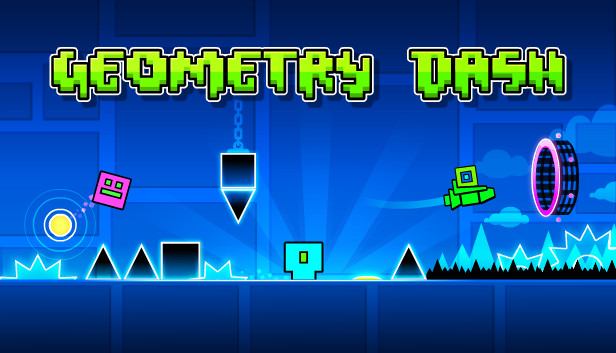
The concept is deceptively simple: guide a square block through a series of obstacle-filled levels, jumping over spikes and navigating tight passages in perfect sync with the music. Every level has its own soundtrack, and the obstacles are designed to the beat — meaning that playing with the music isn't just immersive, it's genuinely strategic. Players who feel the rhythm clear sections that reflex-only players repeatedly fail.
What makes Geometry Dash extraordinary is its difficulty range. The 21 official levels span from approachable introductions to sequences that have taken dedicated players thousands of attempts to clear. Each completion unlocks rewards and keeps the drive to push further alive across hundreds of hours of play. Beyond the official levels, the community-built library of 60 million-plus stages ensures that no matter your skill level, there is always a new challenge calibrated exactly to where you are. Whether you're jumping your first spike or grinding your way through near-impossible late-game content, Geometry Dash always has something waiting for you just beyond your current limit.
Key Details:
| Field | Info |
|---|---|
| Genre | Rhythm Platformer / Arcade |
| Difficulty Level | Variable (Easy to Near-Impossible across 21 official levels) |
| Average Play Time | 5–30 minutes per session |
| Best For | Rhythm game fans, precision platformer players, competitive completionists |
How to Play Geometry Dash?
Getting Started:
- Select a level from the official roster — start with Stereo Madness for the most accessible introduction.
- The square block moves automatically; your only input is jumping.
- Press jump to leap over spikes, nails, and obstacles in time with the music's beat.
- Hold the jump button for multi-jumps to clear larger gaps or chain consecutive obstacles.
- If you hit a spike, restart from the beginning of the level and try to go further on the next attempt.
Basic Controls:
| Key / Input | Action |
|---|---|
Space or ↑ Up Arrow | Jump |
Hold Space or ↑ Up Arrow | Multi-jump |
↑ Up Arrow (vehicle sections) | Steer vehicle up |
↓ Down Arrow (vehicle sections) | Steer vehicle down |
| Left Mouse Click | Alternative jump input |
Objective: Navigate your character through each level without touching any spike, nail, or obstacle. The block moves forward automatically — your only job is timing your jumps to the beat of the music. Complete a level without failing to earn its rewards. There are no mid-level checkpoints in the standard mode — a single contact with a spike restarts the entire level from the beginning.
Geometry Dash Features & Highlights
✓ 21 official levels with escalating difficulty — From beginner-friendly Stereo Madness to near-impossible late-game content, the official roster covers the full spectrum of rhythm-platformer challenge.
✓ Beat-synchronised obstacle design — Every spike, jump, and passage is timed to the level's soundtrack — players who play to the music clear sections that pure reflex play can't handle.
✓ Multiple gameplay modes — The square block is just the beginning; vehicle sections introduce rockets, ships, and other forms that change the control scheme mid-level and demand rapid adaptation.
✓ 60 million+ community-created levels — An effectively limitless library of player-built stages spanning every difficulty level, theme, and creative concept imaginable.
✓ Skill rewards and unlockables — Reach milestones within levels to earn rewards, adding a tangible progression layer on top of the core completion challenge.
Geometry Dash Tips & Strategies
Beginner Tips:
- Listen to the music before focusing on the visuals. Geometry Dash's obstacles are placed to the beat. On your first few attempts of any level, pay attention to the rhythm — you'll start to feel where jumps should land before you can see far enough ahead to react to them visually.
- Don't get frustrated by restarts — they're the mechanic. Every attempt teaches you something specific about the next obstacle. Players who treat each restart as a learning iteration rather than a failure progress dramatically faster than those who approach the game with a "get it right first time" mindset.
- Start with Stereo Madness and stay there until it's clean. The temptation to skip ahead to harder levels is strong, but the early levels build the rhythm-reading and jump-timing foundations that everything harder depends on. Master the basics before escalating.
Advanced Strategies:
- Memorise obstacle sequences, don't just react to them. At the higher difficulty levels, the speed is too fast for pure reaction play. The players who clear late-game content do so through pattern memorisation — they know exactly what comes next because they've seen it dozens or hundreds of times.
- Use practice mode to isolate difficult sections. Most versions of Geometry Dash include a practice mode with checkpoints. Use it to work on the specific section causing repeated failures rather than running the full level from the beginning each time.
- In vehicle sections, think in smooth curves, not sharp inputs. The ship and rocket sections are controlled by holding and releasing — smooth, gradual height adjustments clear tight passages that sharp button presses consistently clip. Train yourself to feather the control rather than press and release abruptly.
What to Watch Out For:
- Speed changes mid-level. Some levels increase or decrease the block's speed partway through. Jump timing that worked perfectly at normal speed will be wrong after a speed change — be ready to recalibrate your rhythm immediately when the pace shifts.
- Gravity flips. Certain levels or sections invert gravity, turning the ceiling into the floor. Everything you've learned about jump timing reverses instantly. When you see a gravity flip portal approaching, mentally prepare to invert all your inputs before passing through it.
Geometry Dash Elements Explained
Rhythm & Music System
The rhythm and music system is the foundation of everything Geometry Dash does — and the reason it has endured as one of the most played games in its genre for over a decade. Every official level has its own dedicated soundtrack, and the placement of every obstacle, speed change, and jump requirement is choreographed to that track's beat, tempo changes, and musical drops.
This synchronisation is more than aesthetic. Players who play to the music — who internalise the rhythm and let it guide their jump timing — consistently outperform those who rely purely on visual reaction. The music tells you when to jump before the obstacle is close enough to see clearly. A musical drop frequently precedes the level's hardest sequence, giving players a rhythmic cue to heighten their focus. Sections that feel visually overwhelming often become manageable the moment a player stops watching the obstacles and starts feeling the beat.
The music system also drives the emotional experience of each run. A well-timed jump at the crescendo of a track produces a satisfaction that silent or randomly scored games simply cannot replicate. The synchronisation between sound and movement is what makes Geometry Dash feel like a performance as much as a game — and what keeps players returning to levels they've already completed.
Level Difficulty System
Geometry Dash's 21 official levels are structured across a difficulty spectrum that begins with genuinely accessible content and ends with challenges that represent some of the hardest obstacle courses in any mainstream game. The three entry levels — Stereo Madness, Back on Track, and Polargeist — introduce the game's core mechanics at speeds and obstacle densities that give new players enough attempts to develop rhythm-reading and jump timing fundamentals.
As the level roster progresses, difficulty escalates through several distinct vectors: speed increases that shrink the window for each jump, obstacle density that requires longer unbroken sequences of perfect inputs, gravity flips and vehicle sections that demand complete control-scheme adaptation mid-level, and visual complexity that can obscure obstacles until they are almost too close to react to.
Each level maintains its own high score list, providing a personal benchmark for improvement and a community comparison point. The combination of a defined difficulty ladder and persistent high score tracking keeps players engaged through both skill development and competitive positioning — always aware of exactly where they stand relative to both their previous personal best and the broader player population.
Community Level System
The community level system transforms Geometry Dash from a 21-level game into an effectively unlimited creative platform. The built-in level editor gives players access to the same tools used to construct the official levels, allowing them to design and publish their own stages with custom music, obstacle layouts, visual themes, and difficulty calibration. The result is a library of over 60 million community-created levels — a number that grows continuously as the global player base contributes new content.
The community library spans every conceivable difficulty tier, theme, and creative approach. Some community levels are faithful recreations of the official game's style, calibrated for specific skill levels the official roster doesn't cover. Others are experimental — pushing the engine's visual and mechanical capabilities in directions the official content never attempts. The best community levels have achieved canonical status in the Geometry Dash community, recognised by name and regarded as milestones of difficulty that define elite player achievement.
Geometry Dash Frequently Asked Questions
Q: How do I get through the vehicle sections of the game? A: Vehicle sections — ship, rocket, and other forms — replace the jump input with a hold-to-ascend, release-to-descend control scheme. Hold the jump button to fly upward and release to descend. The key is smooth, gradual adjustments rather than sharp button presses. Tight passages require feathering the control — brief, light holds and releases — to thread through narrow gaps without clipping the ceiling or floor. Treat the vehicle like flying, not jumping.
Q: Why do I have to restart from the beginning every time I fail? A: Restarting from the beginning is a core design principle of Geometry Dash — it's what makes completions feel genuinely earned. Each attempt builds your pattern knowledge of the full level, and the run-up to difficult sections reinforces the rhythm reading you need to clear them. If you want to practise a specific section without running the full level, use practice mode, which allows checkpoint placement throughout the stage.
Q: How do I access community-created levels? A: Community levels are available through the game's online level browser. Search by name, difficulty rating, or browse featured and highly-rated content. Levels are rated by the community, with the most polished and well-designed stages rising to the top of rankings. You can also search for specific creators whose work you enjoy and play through their full published catalogue.
Q: What rewards do I get for completing levels? A: Completing official levels at various completion percentages unlocks rewards including in-game icons, colours, and other cosmetic items for your character. Certain milestones within levels also unlock additional presents — the specific rewards for each level are revealed as you reach them, providing motivation to push toward completion percentages you haven't yet achieved.
Q: Is Geometry Dash suitable for younger players? A: Yes — Geometry Dash contains no violence, adult content, or inappropriate themes. The challenge is entirely mechanical: timing jumps and navigating obstacles. The game is suitable for all ages and the early levels are accessible enough for younger players to enjoy, while the difficulty ceiling of later content keeps older and more experienced players genuinely challenged for a long time.