















Geometry Dash Wave
Geometry Dash Wave takes the rhythm-platformer DNA of the original Geometry Dash and rebuilds it around a single, deceptively demanding mechanic: flying a rocket through a continuously zigzagging tunnel by holding and releasing one button. It sounds minimal. It is anything but.
Where the original Geometry Dash asks you to jump at the right moment, Geometry Dash Wave asks you to hold precisely the right duration — threading a moving rocket through sharp diagonal passages that never straighten out. The tunnel doesn't offer clear gaps to pass through; it demands that you align your rocket's angle precisely with each turn's geometry, holding to ascend and releasing to descend in a constant, flowing rhythm that mirrors the tunnel's shape. Miss the angle at a corner and your rocket clips the wall and the run resets immediately.
The zigzag design of the tunnel is the game's central innovation. Unlike straight-corridor runners where the hazard is what's in the path, in Geometry Dash Wave the path itself is the hazard — every section of the tunnel wall is a potential failure point if your angle control isn't exact. Barbed wire fences grow unexpectedly from the tunnel walls mid-run, adding dynamic obstacles to an already demanding geometry challenge and creating situations that no amount of tunnel memorisation fully prepares you for.
Fans of the original Geometry Dash will find the visual style immediately familiar — but the control philosophy is entirely different. This is a game about smoothness, angle discipline, and the kind of fine motor control that only repeated runs develop.
Key Details:
| Field | Info |
|---|---|
| Genre | Rhythm Platformer / Arcade |
| Difficulty Level | Hard (angle precision required throughout) |
| Average Play Time | 3–15 minutes per session |
| Best For | Geometry Dash fans, precision control players, rhythm-reflex gamers |
How to Play Geometry Dash Wave?
Getting Started:
- Launch the game — your rocket enters the zigzag tunnel automatically and begins moving forward.
- Hold the left mouse button to make the rocket ascend; release it to descend.
- Match the rocket's angle to the tunnel's diagonal direction as precisely as possible at each turn.
- When the tunnel turns downward, release early enough that the rocket aligns with the new angle before hitting the upper wall.
- When the tunnel turns upward, hold early enough to rise with the new angle before hitting the lower wall.
Basic Controls:
| Input | Action |
|---|---|
| Hold Left Mouse Button | Rocket flies up |
| Release Left Mouse Button | Rocket flies down |
Objective: Navigate the rocket through the endless zigzag tunnel without clipping any wall. The tunnel alternates continuously between upward and downward diagonal passages — your goal is to maintain precise angle alignment at every turn, clearing as many sections as possible to achieve the highest score. Barbed wire fences appear unexpectedly within the tunnel walls, adding dynamic hazards that demand immediate reaction on top of the constant angle management.
Geometry Dash Wave Features & Highlights
✓ Angle-alignment control mechanic — A unique hold-and-release control system that rewards smoothness and precise timing over reaction speed, demanding a fundamentally different skill set from jump-based platformers.
✓ Continuous zigzag tunnel — An endlessly alternating diagonal track that makes the tunnel geometry itself the primary hazard — there are no safe "straight" sections to recover on.
✓ Dynamic barbed wire obstacles — Unpredictable fence hazards that grow from tunnel walls mid-run, ensuring that even memorised sections can present fresh challenges.
✓ Progressive difficulty levels — A structured level progression with increasing tunnel complexity and obstacle density, rewarding players who master the angle discipline the early levels teach.
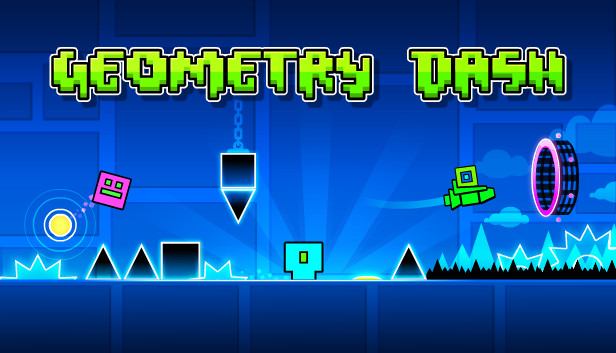
✓ Familiar Geometry Dash visual style — Recognisable neon-lit aesthetic from the Geometry Dash series, with the colour palette and graphic design fans of the franchise will immediately identify.
Geometry Dash Wave Tips & Strategies
Beginner Tips:
- Think in angles, not in up and down. The most common beginner mistake is treating the control as a simple "hold = go up, release = go down" binary. The rocket needs to match the tunnel's diagonal angle precisely — which means the timing of your hold and release must anticipate the tunnel's geometry, not just respond to it.
- Hold and release earlier than feels natural. At every corner, the rocket's momentum means it takes a brief moment to change trajectory after you input. If you wait until the corner is directly ahead to change input, you've already clipped the wall. Initiate holds and releases a fraction of a second before the tunnel actually turns.
- Keep holds and releases short in tight zigzag sections. Long, sustained holds send the rocket too far in one direction. In close-spaced zigzag passages, rapid, brief alternations between holding and releasing keep the rocket centred and manageable.
Advanced Strategies:
- Develop a feel for the tunnel's rhythm as a musical pattern. The zigzag sequence has a timing pattern. Players who internalise that rhythm — treating the alternations like a beat — transition between holds and releases more smoothly than those making visual judgements at each individual corner.
- Treat barbed wire as a secondary focus layer, not the primary one. Angle management always comes first. Players who shift their full attention to incoming barbed wire at the expense of their angle discipline almost always clip a wall in the process. Maintain your angle rhythm and make minor adjustments around barbed wire rather than breaking your control pattern entirely.
- Replay early levels at speed to calibrate your precision. The earlier levels introduce the zigzag pattern at more forgiving angles. Running them at speed — faster than required for completion — trains the fine motor control needed to handle tighter angles in later sections without conscious deliberation.
What to Watch Out For:
- Overholding at upward-angled turns. When the tunnel shifts to an upward diagonal, holding too long sends the rocket into the upper wall before you can release. Develop the habit of releasing slightly early at upward turns — the rocket's upward momentum will carry it through the turn angle without a full-duration hold.
- Barbed wire near tunnel corners. The most dangerous placement of barbed wire is at the corners of zigzag turns, where your angle control is already at its most demanding. When you see barbed wire approaching a turn, prioritise your turn angle first and route around the wire within that constraint — not the other way around.
Geometry Dash Wave Elements Explained
Angle-Alignment Control System
The angle-alignment control system is the mechanic that defines Geometry Dash Wave and separates it categorically from every other game in the Geometry Dash family. The entire game is played with a single input — hold or release — and the skill ceiling of that input is far higher than its simplicity suggests.
The rocket moves continuously forward through the zigzag tunnel. Holding the button causes it to ascend at a diagonal angle; releasing causes it to descend. The challenge is that the tunnel itself is always diagonal — never horizontal — which means the rocket must be angled precisely to match the tunnel's current slope. Too steep an ascent clips the upper wall; too shallow clips the lower. At every corner where the tunnel's diagonal direction reverses, the player must transition between hold and release at the exact moment that keeps the rocket aligned with the new angle.
This demands a qualitatively different kind of motor skill from jump-based games. Jumping is a binary, momentary input — press, release, done. Angle management in Geometry Dash Wave is continuous, dynamic, and forward-looking. The player must be committed to the next corner's input before the current corner has resolved. Players who develop genuine proficiency at this mechanic describe it as flowing — a smooth, rhythmic alternation between hold and release that feels like guiding the rocket through the tunnel rather than reacting to it.
Zigzag Tunnel Design
The zigzag tunnel is not simply a visual theme — it is the game's fundamental difficulty mechanism. Every section of tunnel wall is a potential failure surface, which means there is no "safe" position within the tunnel. In a straight-corridor game, the centre of the passage is the safest position. In Geometry Dash Wave, the centre is only safe for the fraction of a second before the next diagonal change, after which the rocket must have already begun its angle adjustment to avoid the new wall.
The zigzag frequency — how rapidly the tunnel alternates between upward and downward diagonals — is the primary variable that determines each section's difficulty. Wide, slow zigzags give players time to establish a stable angle before the next change. Tight, rapid zigzags demand rapid alternations between hold and release with very little margin for timing error at each transition. Advanced levels combine both frequencies within the same run, requiring players to dynamically adjust their hold-release timing as the zigzag rhythm changes around them.
The tunnel design also makes memorisation a more partial advantage than in jump-based games. Knowing the next corner's direction helps, but knowing it doesn't remove the fine motor requirement of executing the angle transition correctly — which remains a physical challenge regardless of foreknowledge.
Barbed Wire Obstacle System
Barbed wire fences are Geometry Dash Wave's dynamic obstacle layer — the hazard type that prevents tunnel memorisation from becoming a complete solution to the game's challenge. Unlike the tunnel walls themselves, which follow a consistent zigzag pattern that players can learn, barbed wire fences grow from the tunnel walls at irregular intervals and in configurations that vary between runs and levels.
A barbed wire fence that appears mid-section forces the player to adjust their rocket's position within the tunnel without disrupting the angle alignment that keeps them off the walls. This dual-constraint moment — maintain angle, avoid wire, don't clip walls on either side — is the hardest recurring scenario in the game and the one that most reliably ends strong runs.
The most demanding barbed wire placements are at or near zigzag corners, where angle management is already at maximum complexity. In these moments, the game requires simultaneous precision at multiple levels: the timing of the hold-release transition for the corner angle, and the lateral position adjustment needed to route around the wire within the available space. Players who develop the ability to handle these combined demands cleanly — without breaking their angle rhythm for the wire and without neglecting the wire for their angle — represent the highest skill tier the game produces.
Geometry Dash Wave Frequently Asked Questions
Q: How do I control the rocket's angle precisely through tight turns? A: The key is to initiate your hold or release input slightly before the corner, not when it arrives. The rocket's trajectory takes a brief moment to respond to input changes, so timing your transition early ensures the angle has shifted before the tunnel corner demands it. In tight zigzag sections, use brief, rapid alternations between holding and releasing rather than sustained inputs in either direction — this keeps the rocket centred and responsive.
Q: What should I do when a barbed wire fence appears near a tunnel corner? A: Prioritise your corner angle transition first, then route around the barbed wire within the space the correct angle gives you. Players who shift their focus entirely to the wire at the expense of their angle almost always clip a tunnel wall. Maintain your hold-release transition timing for the corner, and treat the wire as a secondary constraint to navigate around within that framework.
Q: How is Geometry Dash Wave different from the original Geometry Dash? A: The original Geometry Dash is primarily a jump-timing game — you press a button at the right moment to leap over obstacles. Geometry Dash Wave replaces jumping with continuous angle management: you hold to ascend and release to descend, guiding a rocket through a zigzag tunnel by matching its angle precisely to the tunnel's geometry. The control mechanic, skill type, and obstacle design are fundamentally different, even though the visual style is from the same family.
Q: Is there a way to practise specific sections of a level? A: Progress through the levels sequentially to build angle-management fundamentals at gentler zigzag frequencies before attempting tighter sections. If a specific angle transition is causing repeated failures, focus several runs on clearing just that section cleanly — identifying the precise moment to initiate the hold or release input — rather than replaying the full level from the start each time.
Q: Is Geometry Dash Wave compatible with mobile devices? A: Geometry Dash Wave's single-button control scheme — hold and release — is compatible with both desktop mouse input and mobile touchscreen tap-and-hold. The game is playable on mobile browsers, making it one of the most accessible Geometry Dash variants across device types. For the most precise angle control at higher difficulty levels, desktop play with mouse input is recommended.