


























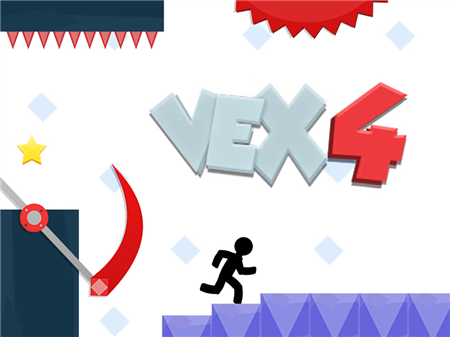
Vex 4
Vex 4 is the fourth chapter in one of the most demanding precision platformer series on the web. You're back in the Vex universe — nine acts of hand-crafted gauntlets filled with saw blades, spike pits, falling platforms, crushing walls, and hazards that have been specifically designed to punish imprecision and reward spatial awareness. The controls are flexible, the physics are sharp, and the traps are, as the series has always promised, genuinely wicked.
What Vex 4 does that the earlier entries refined toward is a sense of fair brutality. Every trap is visible if you look carefully enough. Every death teaches you something specific. The game gives you tools — sprint speed, crawl mechanics for tight corridors, and camera pan for scouting what's coming — and the acts challenge you to use all of them in combination with timing, positioning, and the kind of practiced muscle memory that only repeated attempts build. It is a game that respects your persistence and rewards it.
The nine acts are each distinct in their hazard design and spatial layout, providing variety that keeps the experience from feeling repetitive even as the difficulty climbs. Challenge rooms within each act offer optional additional trials for players who find the core acts insufficiently demanding. A trophy system recognises performance milestones, and Hard Mode versions of each act unlock upon completing the act's assigned tasks — a post-completion layer for the game's most dedicated players. If you've completed Vex 1, 2, and 3, you already know what you're in for. If Vex 4 is your entry point, prepare to learn patience alongside precision.
Key Details:
| Field | Info |
|---|---|
| Genre | Precision Platformer / Skill Game |
| Difficulty Level | Hard (escalates significantly across nine acts) |
| Average Play Time | 10–30 minutes per session |
| Best For | Precision platformer fans, players who enjoy skill-based challenge, Vex series veterans |
How to Play Vex 4?
Getting Started:
- Select Act 1 from the level menu to begin — work through acts sequentially to build the skills later acts demand.
- Move left and right using the arrow keys or A/D; jump with the Up Arrow or W.
- Press Down Arrow or S to crouch and crawl through narrow corridors, or to enter an act when standing above its entrance.
- Pan the camera with the mouse while stationary to scout what lies above or below the current screen view.
- Complete the tasks listed at the bottom of the screen to unlock Hard Mode for each act.
Basic Controls:
| Key | Action |
|---|---|
← / A | Move left |
→ / D | Move right |
↑ / W | Jump |
↓ / S | Crouch / Crawl / Enter act |
| Mouse | Pan camera while stationary |
Objective: Complete all nine acts by reaching each act's exit point without being killed by the traps along the route. Die and restart from the act's last checkpoint — no progress is permanently lost, only time. Complete each act's assigned tasks to unlock its Hard Mode variant. Collect trophies for reaching specific performance milestones across acts. Optional challenge rooms within acts provide additional tests for players who want more.
Vex 4 Features & Highlights
✓ Nine distinct acts — Each act features its own trap configurations, spatial layouts, and hazard combinations, ensuring variety in challenge type across the full game rather than repetition of the same obstacle set.
✓ Hard Mode unlocks — Complete each act's assigned tasks to unlock a harder variant of that act — a post-completion performance layer for players who find the standard version insufficient.
✓ Camera pan scouting — Stand still and use the mouse to pan the camera above or below the current view, revealing hidden traps and upcoming platforms before committing to movement.
✓ Challenge rooms — Optional rooms within acts that present concentrated additional challenges beyond the act's main route, for players pursuing maximum difficulty and trophy completion.
✓ Trophy system — Milestone-based achievements that recognise performance across acts, providing recognition goals beyond simple act completion.
Vex 4 Tips & Strategies
Beginner Tips:
- Use the camera pan before every unfamiliar drop or climb. The camera pan is one of Vex 4's most powerful tools and the one most often ignored by new players. Standing still costs nothing except time — and time is always better spent understanding what's below or above you than discovering it through a death.
- Don't hold the jump button — use precise taps. The jump height in Vex 4 is variable: a tap produces a short hop, holding produces a full jump. Many early-act traps are designed to punish full-height jumps that send you into ceiling spikes. Use the minimum jump height required for each obstacle rather than defaulting to full jumps.
- Treat each death as a lesson about the next trap, not a failure. The act design is consistent — every trap behaves the same way every time. A death always reveals information about the specific hazard that caused it: its timing, its reach, its position. Approach subsequent attempts with that specific knowledge and the same trap becomes significantly easier.
Advanced Strategies:
- Sprint through sections where stopping increases risk. Some trap sequences in later acts are designed to punish hesitation — a saw blade or falling platform that is safely passable at speed becomes dangerous if you slow to assess it mid-section. Identify sections where continuous forward momentum is the correct response and commit to full speed rather than cautious navigation.
- Use wall jumps and ledge mechanics to create alternative routes. Vex 4's physics engine supports wall jumping and ledge grabbing. In acts where the primary route is extremely hazardous, look for wall surfaces and ledge positions that allow alternate paths — these are often faster and less dangerous than the most obvious route.
- Complete Hard Mode on acts you've already mastered, not acts you're still learning. Hard Mode assumes complete familiarity with the act's standard layout. Attempting Hard Mode before the standard version feels comfortable produces overwhelmingly difficult experiences with no baseline to compare against. Complete Hard Mode systematically from Act 1 upward after finishing the full standard campaign.
What to Watch Out For:
- Narrow corridors that require sustained crouching. When the Down key is held through a tight passage, the character crawls. Releasing it mid-corridor where the ceiling is still too low to stand causes an immediate collision. When you enter a narrow passage, keep the Down key held until you can clearly see that standing height is available ahead.
- Traps hidden just outside the default screen view. Vex 4 specifically designs hazards that appear at the edge of or just beyond the visible area — places where the player is moving before they have a chance to see what's coming. Any time you're about to jump to a new platform section or descend into an area below, use the camera pan to reveal what's there first.
Vex 4 Elements Explained
Act Structure & Checkpoint System
Vex 4's nine acts form the game's primary structure, each presenting a distinct spatial challenge with its own hazard vocabulary and difficulty calibration. Acts are not simply harder versions of the same obstacle set — each one introduces different trap types, spatial arrangements, and navigation challenges that require fresh approaches rather than the application of a formula developed in earlier acts. By Act 9, the hazard configurations are sufficiently demanding that skills developed in Act 1 are necessary but nowhere near sufficient.
The checkpoint system makes this escalating difficulty manageable without removing its consequence. Each act contains checkpoints at intervals — after successfully navigating major hazard clusters — that mark the restart position for subsequent deaths within the act. A death returns the player to the last checkpoint reached, preserving the progress made to that point. This design separates learning cost from progress cost: a difficult trap section can be attempted many times without losing the ground cleared before it.
The checkpoint system also means that in-act progression is about checkpoint management as much as obstacle navigation. Reaching a checkpoint before attempting a risky manoeuvre is always preferable to failing the manoeuvre before the checkpoint and losing more than intended. Cautious progress to each checkpoint, followed by focused attempts on the next hazard cluster, is consistently more efficient than aggressive full-act runs that risk resetting from a much earlier point.
Hard Mode & Task System
Vex 4's Hard Mode system extends the game's challenge beyond standard act completion into a second tier of difficulty that assumes full mastery of the base content. Hard Mode versions of each act unlock when the player completes a set of specific tasks associated with that act — tasks that require engagement with the act's mechanics beyond simple completion, such as collecting specific items, achieving particular time thresholds, or reaching positions that require non-obvious navigation.
The task system functions as a structured layer of act mastery that sits between first completion and Hard Mode access. It ensures that Hard Mode is only unlocked by players who have demonstrated genuine familiarity with the act's layout, rather than being immediately available after a single completion that might have involved significant luck. Tasks typically require between two and five dedicated act replays to complete, deepening the player's knowledge of the act's spatial design in the process.
Hard Mode itself modifies the act's hazard density, trap timing, and obstacle placement in ways that require the spatial memory developed through standard and task completion play to navigate. Players who approach Hard Mode without that foundation find it effectively impossible; players who reach it through systematic task completion find it demanding but grounded in familiar territory.
Camera Pan & Scouting System
The camera pan system is Vex 4's most underutilised tool among new players and one of its most sophisticated design decisions. While the character is stationary, moving the mouse allows the camera to pan across a significant area above, below, and to the sides of the character's current position — revealing platforms, traps, and spatial configurations that are hidden from the default view during active movement.
This system is particularly valuable in Vex 4 because the game's hazard design frequently places traps at or just beyond the natural field of view during movement — specifically to create situations where a player moving at speed would encounter them before seeing them. The camera pan subverts this design by making pre-movement reconnaissance available to any player willing to pause and use it.
The scouting system also changes the game's information asymmetry. Without panning, the game holds information about what's ahead until the player is already moving toward it. With deliberate panning, the player can establish a full mental map of the upcoming section before committing to any movement, transforming unknown hazards into known ones with predictable timing and position. Acts that feel impossibly dangerous at first are frequently much more navigable after systematic camera pan reconnaissance at each decision point.
Vex 4 Frequently Asked Questions
Q: How do I enter an act? A: Stand on top of the act's entrance doorway and press the Down Arrow key or S. The character will enter the act from above. The same Down key input is used to crawl through narrow corridors within acts — the game determines which action to perform based on context.
Q: What happens when I die in Vex 4? A: You restart from the most recently reached checkpoint within the current act. No permanent progress is lost — the character immediately returns to the checkpoint position and the act continues from that point. If you die before reaching any checkpoint in the act, you restart from the act's beginning. Death count is tracked but does not affect access to any game content.
Q: How do I unlock Hard Mode for each act? A: Complete the tasks displayed at the bottom of the screen during each act. Tasks vary by act and typically require specific actions such as collecting items, reaching particular positions, or achieving time-based objectives within the act. Completing all tasks for an act unlocks its Hard Mode variant. Check the task list before each act run and plan attempts that specifically address incomplete tasks.
Q: What are challenge rooms and how do I find them? A: Challenge rooms are optional areas embedded within acts that branch off from the main route. They contain concentrated hazard sequences beyond the act's standard difficulty and award trophies upon completion. They are accessible through specific doorways or passages within the act — look for route branches or entrances that diverge from the obvious main path. Challenge rooms are not required for act completion or Hard Mode access, but completing them contributes to the trophy system.
Q: Is Vex 4 significantly harder than Vex 3? A: Vex 4 continues the series' tradition of escalating difficulty across entries, with later acts demanding more precise timing and more complex multi-element navigation than comparable points in Vex 3. Players familiar with the series will find the early acts approachable and the later acts genuinely challenging. New players without Vex series experience should expect a steep learning curve that rewards persistence — the game is intentionally difficult but never unfairly so, with every hazard providing advance visual information to those who look for it.