
















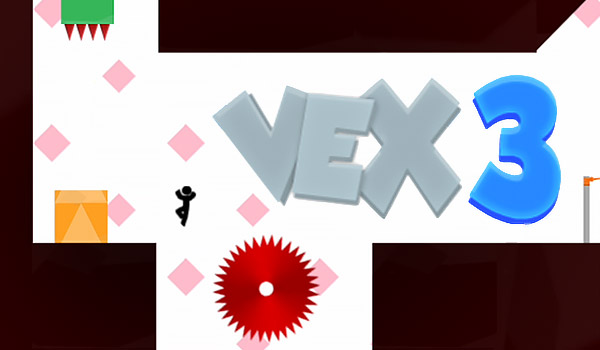
Vex 3
Vex 3 is the third chapter in the beloved precision platformer series, and it arrives with everything fans expect: a stick figure with remarkable agility, ten acts of increasingly devious trap design, and nine dedicated challenge stages that exist purely to test whether you truly know what you're doing. Sprinting, leaping, climbing, swimming, and rolling are all part of the movement vocabulary here — a broader physical range than most platformers of this type, and one that the level design exploits thoroughly.
What defines the Vex series is the relationship between the player and the trap. Every hazard in Vex 3 — the lasers, the spike pits, the moving blades, the crush hazards — has a visible pattern. Nothing is randomised. Nothing is unfair. The game offers information to any player willing to pause and observe, and punishes players who move before they understand what's coming. This philosophy means that Vex 3 is genuinely learnable: a trap that kills you five times in a row becomes a trap you clear reliably on the sixth attempt, because each death has told you something specific about timing, angle, or position.
Key-and-door mechanics add a light puzzle layer to some acts, requiring players to locate and retrieve keys before certain paths open. Moving traps demand pattern memorisation before committing to a crossing. The flagpole checkpoint system — one active at a time — keeps progress intact through difficult sections without removing the consequence of carelessness. Whether you're working through the ten standard stages or pushing into the challenge stage content that awaits beyond, Vex 3 is one of the most satisfying precision platformers in the browser game library — honest, demanding, and deeply rewarding to overcome.
Key Details:
| Field | Info |
|---|---|
| Genre | Precision Platformer / Skill Game |
| Difficulty Level | Hard (escalates across 10 acts; challenge stages are harder still) |
| Average Play Time | 10–30 minutes per session |
| Best For | Precision platformer fans, Vex series players, players who enjoy pattern-based challenge |
How to Play Vex 3?
Getting Started:
- Begin with Act 1 — the early stages introduce movement mechanics and trap types before complexity escalates.
- Move left and right with arrow keys or A/D; jump with Up Arrow or W.
- Press Down or S to crouch, roll, or enter act doorways from above.
- Observe moving traps for at least one full cycle before attempting to pass through them.
- Reach flagpoles to set checkpoints — only the most recently touched flagpole is active.
Basic Controls:
| Key | Action |
|---|---|
← / A | Move left |
→ / D | Move right |
↑ / W | Jump |
↓ / S | Crouch / Roll / Enter act |
Objective: Navigate through each of the ten acts by reaching the exit without being killed by traps. Use flagpoles as checkpoints — dying returns you to the most recently activated one. Locate keys where required to unlock doors that block the act's progression. Complete all ten standard acts, then tackle the nine challenge stages for a harder test of the skills the main acts develop.
Vex 3 Features & Highlights
✓ Ten standard acts plus nine challenge stages — A full campaign of escalating acts followed by dedicated challenge content that assumes mastery of everything the standard acts teach.
✓ Full movement range — Sprint, jump, climb, swim, and roll give the stick figure a wider physical vocabulary than most platformers, and the level design uses every one of those abilities.
✓ Key-and-door puzzle layer — Some acts require locating and retrieving keys to open locked doors, adding a light navigational objective on top of the core trap-avoidance challenge.
✓ Moving trap pattern system — Hazards with observable, repeating movement cycles that reward patience and memorisation over blind reaction speed.
✓ Flagpole checkpoint system — Single-active checkpoints throughout each act that preserve progress through difficult sections without permanently removing consequence.
Vex 3 Tips & Strategies
Beginner Tips:
- Watch moving traps through a full cycle before attempting to cross. The movement pattern of every trap in Vex 3 is fixed and repeating. Spending five seconds observing a trap's full travel path before committing to a cross takes five seconds; failing the cross repeatedly without observation takes far longer.
- Use crouch and roll to pass through narrow passages safely. Many tight corridors and low-ceiling sections can be navigated cleanly by holding Down — the character crouches and rolls through the space without needing jump inputs that would send the head into the ceiling. Recognise low-ceiling sections before entering them.
- Touch every flagpole you pass, even if you feel confident. A flagpole that feels unnecessary when you pass it becomes critical after an unexpected death on a later section. Make flagpole activation a habit rather than a decision.
Advanced Strategies:
- In key-retrieval sections, scout the full path before moving. Some keys require navigating through additional hazards to reach — and the path back from the key to the door is often different from the approach. Understanding the full key retrieval route before moving prevents backtracking through dangerous sections a second time.
- Use wall climbing to create alternative routes through spike-heavy sections. Vex 3's wall climbing mechanic allows the character to ascend and descend vertical surfaces. In acts where the floor route is densely trapped, look for wall surfaces adjacent to the hazards that offer a higher, cleaner path through the same section.
- In challenge stages, treat each attempt as a reconnaissance mission. Challenge stages are designed around hazard combinations that require full understanding before clean navigation is possible. Prioritise information gathering over completion attempts in early challenge stage runs — know every trap's position and pattern before trying to chain the full stage cleanly.
What to Watch Out For:
- Laser hazards that activate on a timed delay. Some laser traps in Vex 3 pulse on and off rather than remaining continuously active. A corridor that appears clear on first visual assessment may have a laser that wasn't at its visible position during your observation window. Always confirm a full cycle — including the off state — before crossing a laser section.
- Water sections changing movement physics. Swimming physics in Vex 3 are different from surface movement — the character moves more slowly and jump mechanics behave differently when entering and exiting water. Approach water sections with reduced speed and adjust your jump timing expectations before the section demands precision.
Vex 3 Elements Explained
Act Structure & Progression System
Vex 3's ten standard acts form a structured difficulty progression that introduces new trap types and movement challenges at a pace calibrated to build skills sequentially rather than throwing everything at the player simultaneously. Early acts establish the fundamentals — basic spike avoidance, simple moving traps, introductory wall climbing — while later acts combine these elements in configurations that require the full movement vocabulary and timing precision the game has developed across the preceding stages.
Each act is self-contained with its own spatial layout, hazard selection, and checkpoint positioning. This structure means that each act feels like a distinct challenge rather than an incremental extension of the previous one — the skills required to clear Act 3 overlap with but don't fully substitute for those required to clear Act 7. Players who approach later acts expecting to apply the same strategies they used in earlier ones without adjustment consistently find the acts more resistant than those who treat each new act as requiring its own analysis.
The nine challenge stages exist outside the main act progression as optional additional content accessible after sufficient standard act completion. They are designed with the assumption that players have internalised the full movement and timing vocabulary of the standard acts, and their hazard density and configuration reflect that assumption. A player who finds the later standard acts difficult will find the challenge stages categorically more demanding.
Key-and-Door Mechanic
The key-and-door mechanic is Vex 3's light puzzle layer — a secondary objective that adds navigational complexity to the acts where it appears without replacing the core trap-avoidance challenge. In relevant sections, a key item must be located and collected before a locked door blocking the act's progression will open. The key is positioned away from the most direct route through the act, requiring deliberate detour through additional trap configurations to retrieve it.
The mechanic works as a challenge multiplier: the act's main route remains the primary hazard sequence, but the key retrieval adds a secondary hazardous path that must be navigated before the locked door becomes accessible. Players who attempt to find the key without first scouting its location tend to navigate unfamiliar trap territory without preparation — a consistently costly approach. Identifying the key's position and the full retrieval path before moving toward it converts an ambush into a known problem.
Key sections also introduce backtracking as a design element — the path from the key back toward the locked door is rarely identical to the approach, requiring the player to navigate the retrieval area in both directions through the same traps, often under different timing conditions on the return pass.
Flagpole Checkpoint System
Vex 3's flagpole checkpoint system balances the game's demanding difficulty against persistent progress by providing spaced respawn points throughout each act. Flagpoles are positioned at intervals across each act — typically after the successful resolution of a major trap section — and touching one activates it as the current checkpoint. Only one checkpoint is active at any time: triggering a later flagpole deactivates any previously held checkpoint.
This single-active design creates a useful pressure mechanic. Progress through an act is preserved by checkpoint, but the checkpoint can only be held at one position at a time — players who are too aggressive in advancing past a new flagpole without securing it lose the insurance of the earlier one. The system rewards deliberate, checkpoint-aware navigation through complex sections while ensuring that catastrophic resets to the act's beginning are reserved for the earliest stages where no flagpole has yet been reached.
The checkpoint positions also implicitly define the act's hazard clusters — each checkpoint marks the boundary between one major trap sequence and the next, giving players a structural map of the act's difficulty even before they've encountered each section. Identifying checkpoints as structural milestones, not just convenient respawn points, makes planning progress through the act easier and more deliberate.
Vex 3 Frequently Asked Questions
Q: How do I enter an act in Vex 3? A: Stand directly above the act's entrance doorway and press the Down Arrow or S key. The character will drop into the act through the entrance. The same Down key input is used for crouching and rolling within acts — the game interprets the input based on the character's current context and position.
Q: What happens when I die before reaching a flagpole? A: If you die before activating any flagpole in the current act, you restart from the act's beginning. The flagpole checkpoint system only activates from the first flagpole you touch — there is no fallback respawn point before that. In acts where the opening section is particularly hazardous, prioritising the first flagpole before any other objective keeps early failures from being maximally costly.
Q: How do I get past locked doors? A: Locate and collect the key associated with the locked door — the key is positioned somewhere within the act, requiring a detour from the main route to reach it. Once collected, return to the locked door and it will open automatically on approach. Scout the key's location before moving toward it to understand the full retrieval path and any hazards on the approach and return routes.
Q: How do the challenge stages differ from the standard acts? A: Challenge stages are separate content from the ten main acts — dedicated levels designed with higher hazard density and more demanding configurations than the standard progression. They assume familiarity with the full movement and timing vocabulary the main acts develop. Challenge stages are not required for main campaign completion but provide significant additional content and difficulty for players who want more after finishing the ten standard acts.
Q: Is Vex 3 significantly harder than Vex 1 and Vex 2? A: Vex 3 continues the series' difficulty escalation, with later acts presenting hazard combinations that build on the foundations established in earlier entries. Players who have completed previous Vex games will find the early acts approachable and the later acts a genuine challenge. New players without series experience should expect a learning curve in the earlier acts that rewards persistence — every trap in the game has a learnable pattern, and no death in Vex 3 is without informational value.