































Temple Run
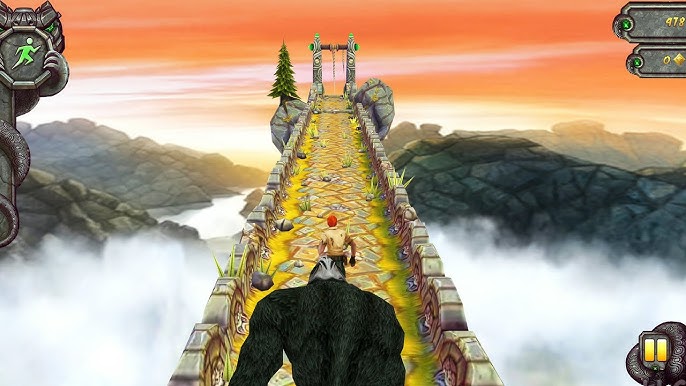
Temple Run is one of the games that defined the endless runner genre — an adventure that begins with the theft of an ancient idol from a cursed temple and ends with a desperate sprint through jungle ruins, rope bridges, cliffs, and underground passages while demonic monkeys close in from behind. Created as a survival escape with no finish line and no mercy, Temple Run has been thrilling players since its original release and remains one of the most recognisable running games ever made.
The setting is what separates Temple Run from its genre peers. You're not running along a track or a subway — you're fleeing through a procedurally changing ancient temple environment where the terrain shifts without warning: a sudden sharp turn that drops you off a cliff if you're not ready, a waterfall crossing that floods the path, wooden barriers that ignite as you approach, and tree roots that trip the unwary. The game's background is in constant motion, replacing familiar sections with new configurations that keep the visual environment fresh and the navigation challenge genuine.
What makes Temple Run enduringly compelling is how it pairs the pure survival tension of a chase game with a meaningful upgrade economy. Gold collected during each run funds power-ups, character unlocks, and ability upgrades that compound in value across sessions. The character roster includes multiple distinct adventurers, each with their own look and special abilities that provide subtle but tangible run advantages. Power-ups like the coin magnet, score multiplier, and shield extend what any given run can achieve and elevate the ceiling for what experienced players can accomplish. If you want an endless runner with the atmosphere of a jungle adventure and the depth of a progression game, Temple Run remains the gold standard.
Key Details:
| Field | Info |
|---|---|
| Genre | Endless Runner / Action Adventure |
| Difficulty Level | Variable (speed escalates continuously with distance) |
| Average Play Time | 3–15 minutes per run |
| Best For | All ages, action-adventure fans, endless runner veterans, progression collectors |
How to Play Temple Run?
Getting Started:
- Launch the game — your adventurer begins sprinting through the temple ruins automatically.
- Swipe or use arrow keys to turn left or right at path junctions — missing a turn sends you off the edge.
- Jump over roots, gaps, and low obstacles by swiping up or pressing the Up Arrow.
- Slide under hanging beams and overhead hazards by swiping down or pressing the Down Arrow.
- Tilt your device or use Left/Right Arrow to shift lanes on wider path sections to collect gold and avoid obstacles.
Basic Controls:
| Key | Action |
|---|---|
← Left Arrow | Turn left / Move left |
→ Right Arrow | Turn right / Move right |
↑ Up Arrow | Jump |
↓ Down Arrow | Slide |
W / A / S / D | Alternative WASD controls |
Objective: Run as far as possible through the temple environment without falling off the path, colliding with an obstacle, or being caught by the pursuing creatures. Collect gold coins along the route to fund power-ups and character upgrades. Use power-ups picked up during runs to extend distance and boost score. The game continuously increases speed the further you run — the longer you survive, the more demanding every split-second decision becomes.
Temple Run Features & Highlights
✓ Dynamic changing environment — The temple setting shifts continuously across jungle paths, rope bridges, cliffs, waterfalls, and underground passages, ensuring no two run sections feel identical.
✓ Multiple playable characters — A roster of distinct adventurers each with unique designs and special abilities that provide tangible run advantages beyond pure cosmetic variety.
✓ Power-up suite with upgrade system — Coin Magnet, Score Multiplier, Shield, Boost, and more — each upgradeable with collected gold for extended duration and stronger effect.
✓ Gold collection and progression economy — Gold earned during runs funds character unlocks, power-up upgrades, and ability improvements that compound in value across many sessions.
✓ Demonic pursuit mechanic — The ever-present threat of the temple's guardian monsters creates a genuine chase atmosphere that no purely obstacle-based runner can replicate.
Temple Run Tips & Strategies
Beginner Tips:
- Prioritise turns over coin collection. A sharp turn is the most common cause of early run deaths — missing it sends you off the path immediately. When a turn and a coin cluster appear simultaneously, take the turn cleanly first. Coins are abundant; the run is not recoverable from a missed turn.
- React to turns as soon as they appear in the distance. Temple Run's turns are telegraphed visually before the path reaches them. New players who wait until the turn is immediately ahead have already lost most of their reaction window. Identify turns one to two seconds ahead and input the direction early for a clean transition.
- Use the shield power-up to survive one mistake, not to avoid all obstacles. The Shield absorbs one collision and then expires. Its value is in extending a promising long run past a single unavoidable hazard, not in providing general invincibility. Save shield activations for moments where an obstacle is genuinely unavoidable given the current run speed.
Advanced Strategies:
- Upgrade the Score Multiplier before other power-ups. Of all upgradeable power-ups, the Score Multiplier has the greatest compounding effect on total run points — a longer active duration directly increases your leaderboard score for every second it's running. Upgrading it first provides the fastest return on gold investment for competitive players.
- Learn to combine jump and turn inputs simultaneously. At high speeds, many obstacle configurations require both a directional change and a jump in near-simultaneous sequence. Players who can input both within the same decision window clear sequences that feel impossible to those processing them as sequential choices. Practice the double-input pattern on moderate-speed sections so it becomes instinctive at high speed.
- Collect gold from the sides of the path as well as the centre. The tilting mechanic shifts your character across the width of the path to reach coins in outer lanes without committing to a full lane change. Using tilt for outer-lane gold collection while maintaining your turn-ready position in the centre is the most efficient coin farming technique for experienced players.
What to Watch Out For:
- Speed escalation after long power-up phases. Power-ups like the Coin Magnet and Boost partially automate navigation for their duration. The game's speed increases during these phases, which means the transition back to full manual control after a power-up expires requires recalibrating to a faster track pace. This moment of readjustment is where many long, promising runs end.
- Fire hazards that obscure the path ahead. Certain terrain sections in Temple Run feature fire effects that partially obscure the upcoming path, making turns and obstacles harder to identify early. When you see fire visuals, increase your scan distance — look further ahead than usual to compensate for the reduced visibility of the immediate path.
Temple Run Elements Explained
Dynamic Environment System
Temple Run's dynamic environment system is the feature that gives the game its adventure atmosphere and prevents the visual experience from becoming repetitive across long play sessions. Rather than a single repeated track texture, the game cycles through distinct environment types — sunlit jungle paths, vine-covered ruins, underground cave passages, rope bridges over chasms, waterfall-flanked cliff routes — combining them in configurations that vary between runs and shift within individual sessions as distance increases.
Each environment type introduces its own visual hazards and navigational context. Jungle paths feature dense root systems and low-hanging branches. Cliff routes narrow the safe running zone and make lateral position management more consequential. Underground sections change the lighting conditions and introduce ceiling hazards that require slide responses. Waterfall crossings alter the terrain texture and introduce splashing visual effects that partially obscure obstacle positions.
The changing backgrounds function both aesthetically and functionally: aesthetically, they make long runs feel like genuine journeys through varied terrain rather than repetition of a single loop; functionally, they introduce environment-specific hazards that require the player to adapt their obstacle identification habits as the scenery shifts. Players who learn to read each environment type's characteristic hazard patterns as they transition navigate the changes faster than those reacting to each new element from scratch.
Power-Up & Upgrade System
Temple Run's power-up system features five distinct run advantages — Coin Magnet, Score Multiplier, Shield, Mega Coin, and Boost — each collectable from the path during runs and each upgradeable with gold to extend their active duration and enhance their effect. The upgrade system is accessible between runs from the main menu and represents the primary use of accumulated gold beyond character unlocks.
The Coin Magnet draws nearby gold toward the runner without requiring lateral movement, dramatically increasing collection yield in dense coin sections. The Score Multiplier applies a compounding factor to all points earned during its active window — the most directly impactful upgrade for leaderboard performance. The Shield absorbs one collision with an obstacle or fall from the path before expiring, effectively granting an extra life during its activation period. Mega Coin provides an instant large gold bonus on activation. Boost provides a temporary speed surge that extends distance covered while active.
Upgrading power-up durations with gold provides the highest return on gold investment for players focused on score performance. A fully upgraded Score Multiplier active during a long run produces point totals that multiple uninvested runs cannot achieve, making systematic upgrade investment more valuable than rapid character collection for players who prioritise leaderboard competitiveness.
Character & Ability System
Temple Run features a roster of playable characters — each with a distinct visual design representing a different adventurer archetype — and a complementary ability upgrade system that improves specific aspects of each character's performance across runs. Character unlocks are purchased with gold, and each character's associated abilities can be progressively upgraded using additional gold to provide further run advantages.
Character abilities typically affect specific performance domains: improved resistance to a particular obstacle type, extended power-up duration, enhanced coin collection radius, or increased score multiplier baseline. These differences are subtle in early upgrade tiers but meaningfully impact run potential at higher tiers, creating a genuine incentive to invest in specific characters rather than simply collecting them for visual variety.
The character and ability system provides Temple Run's longest-term progression goal — a full roster of maxed characters represents hundreds of runs' worth of gold accumulation — while ensuring that each incremental investment produces a tangible in-run benefit that motivates the next session. Players who engage seriously with character development find their average run distance and score ceiling increasing systematically across weeks of play, independent of any improvement in raw reflex speed.
Temple Run Frequently Asked Questions
Q: How do I handle sharp turns without falling off the path? A: Identify turns as soon as they appear in the distance — they are visually telegraphed before the path reaches them — and input the turn direction early rather than waiting until you're at the corner. At higher speeds, reacting at the corner itself is often too late. Additionally, avoid collecting coins near the outer edges of the path when approaching a turn: the outer-lane position reduces your margin for the turn input. Take the turn from the centre of the path for the cleanest transition.
Q: What should I do if I keep dying at the same terrain section? A: Identify the specific obstacle or hazard type causing the failure — whether it's a turn, a root, a beam, or an edge — and focus one attempt specifically on clearing that single element cleanly before running fully. At high speed, terrain types that require simultaneous inputs (turn + jump, or slide + lateral shift) are the most common late-run failure points. Practice the required input combination on similar obstacles earlier in the run where the lower speed gives you more time to execute it.
Q: How do I unlock new characters? A: Characters are purchased in the in-game shop using gold accumulated during runs. Each character has a specific gold cost visible in the character selection menu. Some characters may also be unlockable through special event rewards or premium currency. The gold requirement for mid-to-high roster characters is substantial — consistent run performance and power-up upgrade investment (particularly the Coin Magnet) significantly accelerates the collection timeline.
Q: Which power-up should I upgrade first? A: The Score Multiplier provides the highest return on upgrade gold for players focused on leaderboard performance — each upgrade tier extends its active duration, directly compounding the points earned during every run where it's active. The Coin Magnet is the best first upgrade for players who want to accelerate their gold accumulation and unlock timeline — automatic coin collection at an extended range increases every subsequent run's gold yield. Prioritise Score Multiplier for score performance, Coin Magnet for progression speed.
Q: Does Temple Run get faster the further you run? A: Yes — the game's speed increases continuously as your run distance grows. Early in each run the pace is manageable, giving new players time to learn obstacle patterns. As distance accumulates, the speed escalation becomes increasingly demanding: turns that allow comfortable reaction time at lower speeds require near-immediate response at high speeds, and obstacle combinations that are avoidable individually become genuinely challenging at pace. The speed escalation has no ceiling — the game runs as fast as you can survive it.