












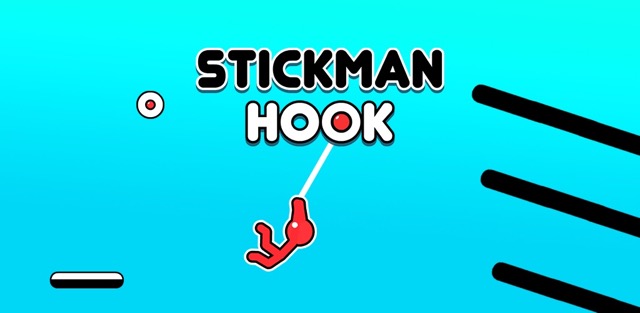
Stickman Hook
Stickman Hook is a physics-based swinging game that makes one mechanic — attach, swing, release — feel endlessly satisfying across more than 100 levels of escalating challenge. You control a stickman who swings through mid-air via grappling hook, chaining momentum from one anchor point to the next in a fluid arc of movement that, when it clicks, feels as smooth and expressive as any platformer in the genre.
The core loop is deceptively simple. Click or tap to hook your stickman to a nearby anchor. Let the pendulum swing build momentum. Release at the precise moment that sends you flying in exactly the direction you need. Hook the next anchor and repeat. What starts as a gentle introduction to the mechanic quickly layers in obstacles, tighter spacing between hooks, and more demanding release timing — all without ever changing the fundamental one-input control scheme.
What makes Stickman Hook compelling over 100+ levels is how much skill expression exists within that single input. The difference between a clumsy, barely-managed swing and a fluid, momentum-conserving chain is entirely about timing and reading trajectory. Good players flow through levels; players still learning the mechanic clatter through them. Both are having fun, but the game rewards the investment in getting better.
Bouncy pads add another dimension of airtime and bypass opportunities. A roster of unlockable skins gives dedicated players cosmetic goals to pursue. And the satisfaction of completing a tough level — followed by the stickman's victory dance — is a small but reliably earned moment of triumph.
Key Details:
- Genre: Physics / Swing Platformer / Skill-Based Arcade
- Difficulty Level: Variable (Easy start, Hard progression)
- Average Play Time: 10–20 minutes per session
- Best For: Players who enjoy momentum-based physics games, skill-progression platformers, and satisfying one-mechanic challenge games
How to Play Stickman Hook?
Getting Started:
- Begin the level — your stickman is positioned at the starting point with anchor hooks visible ahead.
- Click or tap to attach to the nearest useful hook and begin your pendulum swing.
- Build momentum through your swing arc, then release at the point in the arc that sends you toward the next hook.
- Hook again and continue chaining swings, adjusting your release timing based on the gap ahead and any obstacles in your path.
- Reach the finish line to complete the level and unlock the next stage.
Basic Controls:
- Left Mouse Click / Spacebar — Hook / Release (desktop)
- Tap — Hook / Release (mobile)
Objective: Swing your stickman from the start to the finish line of each level by chaining hook attachments and momentum-timed releases. Avoid obstacles that block your path. Falling before reaching the finish line restarts the level from the beginning.
Stickman Hook Features & Highlights
- 100+ levels — A full progression of swinging challenges that escalate in obstacle density, hook spacing, and release timing demands
- Single-mechanic depth — The click-to-hook, release-to-fly input system is immediately accessible but offers genuine skill expression through timing mastery
- Bouncy pads & trampolines — Level elements that provide extra airtime, obstacle bypasses, and momentum boosts when used at the right angle
- Unlockable skins — Cosmetic stickman customization available as progression rewards for dedicated players
- Full-screen mode — Optional expanded view for a more immersive swinging experience
Stickman Hook Tips & Strategies
Beginner Tips:
- Release on the forward arc, not at the top of the swing. Releasing when your stickman is moving forward and slightly upward produces the most useful trajectory — releasing at the arc's peak often sends you straight up rather than forward.
- Hook to anchors that are positioned ahead of you, not behind. Not every hook in a level is useful — skip ones that would pull you backward or sideways off your intended path.
- If you're stuck on a level, a fresh restart often reveals a better approach angle. Familiarity with a level's layout is frequently the difference between a clean run and a scrambled one.
Advanced Strategies:
- Build momentum intentionally before tight obstacle sections. Extra speed through a difficult gap requires more precise timing, but it's often faster and safer than slowing down and threading the needle at low speed.
- Use bouncy pads as trajectory correctors, not just speed boosts. A well-angled bounce can bypass an entire obstacle cluster that sequential swinging would require careful navigation through.
- In later levels with multiple possible hook sequences, look for the line that keeps your swing arcs lower to the obstacles rather than high — high arcs offer dramatic momentum but leave less room for course correction.
What to Watch Out For:
- Holding too long on a swing — Holding past the optimal release point causes the stickman to swing backward and lose height. If you miss a release window, let the backward arc complete and set up a new forward release rather than releasing in the wrong direction.
- Hooking every available anchor — Attaching to anchors that aren't on your optimal path bleeds momentum and creates awkward trajectories. Be selective; only hook what moves you forward efficiently.
Stickman Hook Elements Explained
Swing & Momentum Mechanic
The pendulum physics in Stickman Hook are the game's entire mechanical vocabulary, and they're deep enough to sustain 100+ levels of meaningful challenge. When your stickman attaches to a hook, it enters a pendulum arc whose speed is determined by the height of the attachment point relative to the stickman's current position and the momentum carried from the previous swing. This means each release decision carries context from the last one — conserving momentum through clean release timing produces faster, more controlled subsequent swings, while poor release timing dissipates speed and forces a rebuild. The most satisfying runs in Stickman Hook are chains where each release flows naturally into the next attachment, the stickman never losing altitude or speed across multiple hooks in succession. Learning to read the optimal release point — the specific moment in the forward arc where trajectory, speed, and direction align for the next hook — is the central skill of the game.
Level Design & Obstacle Progression
Stickman Hook's 100+ level progression introduces complexity gradually without ever adding new mechanics — all levels use the same one-input hook-and-release system. What changes is the configuration: early levels feature widely spaced hooks with minimal obstacles and generous timing windows. As levels advance, hook spacing tightens, obstacles enter swing paths, and timing windows narrow until only clean, precise releases will clear the course. The level design is carefully crafted around the physics engine — obstacles are positioned to punish common timing mistakes (releasing too early, holding too long) while rewarding the correct approach with clear pathways. This design philosophy means difficult levels rarely feel arbitrary; they're teaching specific timing skills by making the wrong approach costly and the right approach satisfying.
Bouncy Pads & Environmental Elements
Bouncy pads and trampolines appear in various levels as supplementary launch tools that add vertical momentum and change possible trajectories. They function differently from hooks: rather than attaching and swinging, your stickman bounces off the pad surface with directional momentum determined by the contact angle. A well-timed bounce from the right approach can send your stickman over an obstacle cluster that sequential swinging would require careful threading through, or provide the height needed to reach a hook that's otherwise above your swing arc's ceiling. Combining bouncing with swinging at complementary angles is an advanced skill — the best use of a bouncy pad is rarely the most obvious one, and experimenting with different approach angles often reveals shortcuts that straightforward paths through a level don't offer.
Stickman Hook Frequently Asked Questions
Q: How do I build more momentum while swinging? A: Momentum is preserved through clean release timing and reattachment on the forward arc. Releasing at the peak of your forward swing and immediately hooking the next anchor without losing height compounds speed across multiple swings. Avoid releasing backward or at the arc's top — both dissipate speed rather than transferring it.
Q: What should I do if I can't reach the next hook? A: Look for bouncy pads in the level that can provide additional height or forward momentum. If no pad is available, try attaching to a hook higher or further back in the level that generates a longer swing arc — more height at the top of the pendulum translates to more forward speed on the release.
Q: Is Stickman Hook compatible with mobile devices? A: Yes. The tap-to-hook control scheme is natively designed for touchscreen play, and the game runs in modern mobile browsers without installation. Desktop play via mouse click or spacebar is equally supported.
Q: Can I save my level progress and unlocked skins? A: Yes. Completed levels and unlocked skins are saved automatically in your browser. Returning to the game in the same browser resumes from your last completed level with all unlocks intact.
Q: How do I unlock new skins? A: Skins are unlocked through level completion and progression milestones. Continue advancing through the level sequence and skins become available as rewards at specific completion thresholds — no separate purchase or action required beyond playing through the game.