























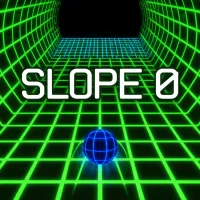
1. Slope Zero Overview
Slope Zero is a fresh iteration on the Slope formula that makes one significant philosophical shift: instead of measuring survival time, it measures distance covered. It sounds like a minor change, but it reframes how every decision in a run feels. A spinning platform that launches the ball forward isn't just a hazard to manage — it's a potential distance multiplier. A ramp that sends the ball airborne isn't just a moment of danger — it's an opportunity to cover ground at a rate flat-surface rolling can't match. Distance as the metric makes the game's power-ups feel genuinely strategic rather than defensive.
Those power-ups are Slope Zero's most distinct contribution to the genre. Jump boosts launch the ball to heights standard rolling doesn't reach. Slowdown temporarily reduces the pace to a manageable level during stretches where speed has outrun your current reflex calibration. A 2x points multiplier doubles the distance value of every meter covered while it's active. These aren't the passive shields and magnets of most slope games — they're active interventions that change how a run plays out, and choosing the right moment to activate each one is a meaningful tactical decision.
The new obstacles extend the challenge in directions the classic formula hasn't explored. Spinning platforms introduce rotational movement that standard avoidance skills don't fully prepare you for — the platform may be safe when you start steering toward it and dangerous by the time you arrive, requiring prediction of its rotation rather than reaction to its current state. Red walls serve as channel constraints that force the ball through narrower corridors at speed. Together with ramps that can produce huge distance gains if landed cleanly, Slope Zero creates a variant that feels genuinely evolved rather than merely reskinned.
Key Details:
| Genre: | Endless Runner / 3D Arcade |
| Difficulty Level: | Medium to Hard |
| Average Play Time: | 5–15 minutes per run |
| Best For: | Slope veterans seeking fresh mechanics; distance-focused players who enjoy strategic power-up deployment |
How to Play Slope Zero?
Getting Started:
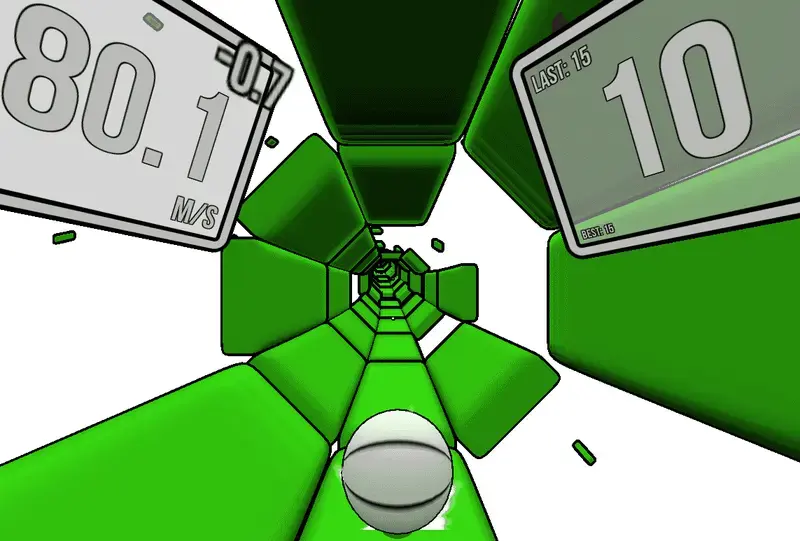
- The ball begins rolling automatically down the neon track — steer from the very first second.
- Use A/D or the Left/Right arrow keys to steer the ball.
- Avoid spinning platforms (predict their rotation) and red walls (stay in the open channel between them).
- Use ramps and power-ups to cover large distances quickly — but ensure clean landings after ramp launches.
- Retry after each run with refined strategies to push your distance record further.
Basic Controls:
| Action | Key |
| Steer Left | A or ← Left Arrow |
| Steer Right | D or → Right Arrow |
Objective: Cover the greatest distance possible on the endless neon track. Use ramps and power-ups strategically to maximize distance per run. Avoid spinning platforms and red walls, and land cleanly after every ramp launch to keep the run alive.
Slope Zero Features & Highlights
✓ Distance-based scoring — a shift from survival time to distance covered that reframes how power-ups and ramps feel as strategic tools
✓ New power-up types — 2x points, jump boost, and slowdown offer distinct tactical applications unlike the standard shield/magnet formula
✓ Spinning platform obstacles — a new obstacle type requiring rotation prediction rather than simple position avoidance
✓ Ramp distance multipliers — ramp launches can cover huge ground instantly, rewarding players who master the approach speed and landing
✓ Red wall channel obstacles — corridor-constraining walls that force precise navigation at high speed
Slope Zero Tips & Strategies
Beginner Tips:
- Understand the distance-as-score metric before your first serious run: ramps and jump boosts are your friends, not just hazards. Every meter of airborne distance from a ramp counts the same as ground-level distance.
- Use the slowdown power-up proactively when the speed feels like it's about to exceed your control — don't wait until you're already failing. It's most effective when deployed slightly before a situation becomes critical.
- For ramp launches, approach centered and at a controlled speed — going too fast into a ramp can launch the ball too far to land on the track's far side.
Advanced Strategies:
- The 2x points power-up is most valuable during a ramp launch or after a jump boost — activating it during a period of rapid distance gain multiplies its effect. Save it for moments when you're already covering ground quickly.
- Spinning platforms follow fixed rotation cycles. Watch one full rotation before committing to a pass — the gap in the rotation that's safe for crossing will repeat predictably, giving you a timing window you can plan around rather than react to.
- Chain ramp launches when the track allows — multiple sequential ramps with clean landings between them produce distance totals that flat-surface running couldn't approach in the same time.
What to Watch Out For:
- Ramp landing imprecision: A ramp launch that covers great distance but lands off the track edge is a run-ender regardless of how impressive the airtime was. Ensure your horizontal position is centered before a ramp approach — a centered launch produces a centered landing.
- Spinning platform timing drift: At high speed, the time between seeing a spinning platform and arriving at it shortens significantly. At slow speeds you have time to watch a full rotation; at high speeds you may only see half of one. Develop a feel for extrapolating the platform's position from partial observation.
Slope Zero Elements Explained
Distance Scoring and Its Implications: The shift from survival-time scoring to distance-covered scoring is Slope Zero's foundational design decision, and it has ripple effects throughout the game's mechanics. In a time-based game, ramps and jump boosts are neutral or positive — they keep you alive. In a distance-based game, they're active score multipliers — airborne distance counts, ramp launches can cover in one second what flat rolling covers in five. This changes how players should think about every element of the track: speed-up ramps become opportunities rather than hazards, the slowdown power-up becomes a precision tool for surviving to the next ramp, and the 2x points power-up becomes most valuable when combined with a period of rapid movement. The entire tactical framework of Slope Zero is built on this scoring foundation.
New Obstacle Types: Slope Zero introduces two obstacle types not found in the classic Slope formula. Spinning platforms are rotating surface segments that alternate between being safe and being dangerous as they rotate through their cycle. Unlike static obstacles that have a fixed dangerous position, spinning platforms require prediction — you need to know where the platform will be when you arrive, not where it is when you first see it. This is a genuinely different cognitive demand from standard obstacle avoidance. Red walls act as channel constraints, narrowing the track into corridors of varying width. They require precise horizontal positioning rather than reactive dodging — entering a red wall channel off-center at high speed leaves insufficient correction room. Both new obstacles reward anticipation and preparation over reaction.
Power-Up System: Slope Zero's three power-ups represent a deliberate expansion of the standard slope game power-up model. The Jump Boost launches the ball to unusual heights, useful for clearing large gaps or reaching elevated track sections. The Slowdown temporarily reduces the ball's speed, giving players a brief window of more manageable pace during particularly demanding sections. The 2x Points multiplier doubles the distance value of every meter covered while active — not the most dramatic effect in a single activation, but compounding significantly over a well-timed deployment during a fast or ramp-heavy section. Unlike games where power-ups are passive pickups, Slope Zero's power-ups reward deliberate timing: the same power-up deployed at the right moment is significantly more valuable than at a random one.
Slope Zero Frequently Asked Questions
Q: How is the scoring in Slope Zero different from other slope games? A: Slope Zero scores based on distance covered rather than survival time. This means ramp launches and jump boosts actively contribute to your score by covering ground quickly — they're score multipliers as well as navigation tools. In standard slope games, these would only be hazards to manage.
Q: What should I do if I keep crashing on landing after ramp launches? A: Ensure you're approaching the ramp centered — your horizontal position at launch determines your horizontal position at landing. Also check your approach speed: too fast and the launch carries you past the track's far side; too slow and you don't clear whatever the ramp was designed to bridge.
Q: When should I use the slowdown power-up? A: Use it slightly before a situation becomes unmanageable — when you're aware that the current speed is approaching your reflex limit. Using it reactively after you've already made an error is often too late to help. Proactive slowdown during a difficult section is more effective than emergency slowdown after a near-miss.
Q: Is Slope Zero available on mobile? A: Slope Zero uses A/D and arrow key controls and is best played on a desktop or laptop browser. Mobile touchscreen support may be limited.
Q: Can I save my high score between sessions? A: High scores are typically stored in your browser session. Clearing browser data or cookies may reset your recorded distance.