



























1. Slope Ball Run Overview
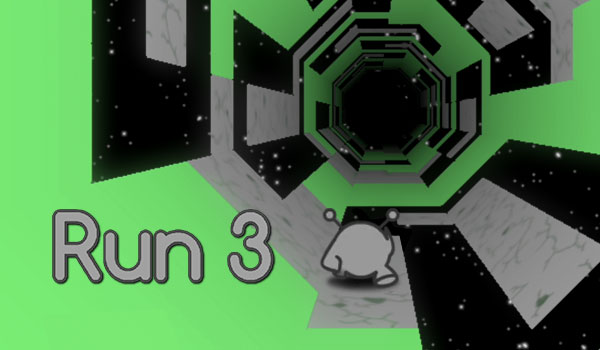
Slope Ball Run is the intersection of two beloved game formats — the Slope series and Run 3 — merged into something neither could be individually. You're rolling a ball through a space tunnel on a mission to find its way back to Earth, and the tunnel is rectangular, meaning you can use all four of its sides as your floor. Rotate the tunnel by steering left or right, and the hole that would have swallowed you from below suddenly becomes the wall beside you. It's a spatial puzzle that plays out at speed, and it's genuinely unlike anything else in the slope genre.
The story framing gives the game an unusual sense of purpose for an endless runner. A small ball, adrift in space, navigating a tunnel full of dangerous holes with a sparkling star field visible beyond its walls — it's a simple premise but one that makes the space setting feel like more than a backdrop. The visual design of the space tunnel, lit against infinite dark sky, creates an atmosphere that's quietly beautiful even in the middle of a high-pressure dodge sequence.
Holes are the primary challenge, but Slope Ball Run layers in gray bricks that add a second hazard type with its own mechanical logic. Gray bricks sink when rolled over, giving you a brief window to move to safe tiles before they collapse completely. This creates moments where the game shifts from pure avoidance to active surface management — recognizing a gray brick section early and routing to stable tiles before the instability cascades. Combined with the tunnel rotation mechanic and a jump ability for clearing holes directly, Slope Ball Run gives players three distinct tools for survival and demands they know when to use each one.
Key Details:
| Genre: | Endless Runner / Space Tunnel Platformer |
| Difficulty Level: | Medium to Hard |
| Average Play Time: | 5–15 minutes per session |
| Best For: | Run 3 and Slope fans; players who enjoy spatial rotation mechanics and multi-tool survival gameplay |
How to Play Slope Ball Run?
Getting Started:
- The ball begins rolling forward automatically through the space tunnel — steer immediately.
- Use the Left and Right arrow keys to move the ball sideways — this also rotates the tunnel.
- Press the Up arrow key to jump over holes when steering around them isn't possible.
- Avoid holes (the ball falls into space) and gray bricks (they sink — move to solid tiles quickly).
- Conquer each level's tunnel configuration and advance to the next.
Basic Controls:
| Action | Key |
| Move Left / Rotate Tunnel Left | ← Left Arrow |
| Move Right / Rotate Tunnel Right | → Right Arrow |
| Jump | ↑ Up Arrow |
Objective: Guide the ball through the space tunnel by steering, rotating the tunnel, and jumping over holes. Avoid falling into space through gaps, and navigate away from gray bricks before they sink. Complete each level's tunnel to advance, conquer as many levels as possible.
Slope Ball Run Features & Highlights
✓ Tunnel rotation mechanic — steering rotates the entire rectangular tunnel, turning potential floor-holes into avoidable wall-holes in a genuinely unique spatial mechanic
✓ Three survival tools — steer, rotate, and jump provide distinct responses to different hazard types, adding tactical depth beyond single-input slope games
✓ Gray sinking bricks — a secondary hazard that introduces surface management alongside hole avoidance, requiring both speed and spatial awareness
✓ Space narrative setting — a ball finding its way back to Earth through a star-filled space tunnel gives the endless runner format an unusual sense of purpose and place
✓ Level-based progression — structured levels replace the pure endless format, giving players defined milestones and increasing challenge across a series of tunnel configurations
Slope Ball Run Tips & Strategies
Beginner Tips:
- Understand the tunnel rotation before anything else — steering left or right doesn't just move the ball, it rotates the entire tunnel. A hole beneath you can become a wall hole beside you with a quick steer. Practice this intentionally in early levels before the pace becomes demanding.
- Jump is your emergency tool, not your primary one — use steering and rotation first. Jumping over holes works cleanly but leaves you committed to a single landing spot; steering gives you more flexibility.
- Gray bricks look different from solid tiles — learn their appearance quickly. The moment you identify a gray brick section ahead, plan your exit route to solid tiles before you're on top of them.
Advanced Strategies:
- On sections with multiple consecutive holes, use rotation to convert floor-holes into side-holes whenever possible — this keeps the ball on a solid surface rather than requiring a jump for each gap.
- Combine jump and rotation for complex hole configurations: rotate to bring the ball to a tunnel wall with fewer holes, then jump a remaining gap from the new surface position.
- In later levels, gray brick sections become denser. Route through them diagonally — crossing from one edge of a gray section to the other at an angle hits fewer consecutive sinking bricks than a straight-across path.
What to Watch Out For:
- Rotation overcommitment: Rotating the tunnel too far in one direction to avoid a hole can bring a different set of holes into your floor position. Plan your rotation amount carefully — sometimes a partial rotation is more effective than a full one.
- Gray brick cascade: If you stay on a gray brick section too long, multiple bricks sink simultaneously, creating a rapidly expanding unstable zone. The moment you identify gray bricks, move — don't wait to see if they'll actually sink before reacting.
Slope Ball Run Elements Explained
Tunnel Rotation Mechanic: The rectangular tunnel is the game's defining mechanical feature. Unlike a standard slope game where the platform is fixed and the ball moves across it, Slope Ball Run's tunnel can be rotated by the player's left-right steering input. Moving left rotates the tunnel counterclockwise; moving right rotates it clockwise. This means a hole directly in the ball's path can be moved out of the floor position and into a wall position by a quick directional input — effectively converting an unavoidable floor gap into a navigable wall gap. This mechanic requires spatial thinking that slope games don't typically demand: you're not just reacting to where holes are, but actively managing which surface of the tunnel you're treating as your floor.
Gray Sinking Bricks: Gray bricks are the game's second major hazard type and function on entirely different logic from holes. Where holes are permanent absent sections of the tunnel that must be avoided or jumped, gray bricks are unstable solid tiles that sink progressively when the ball rolls over them. This creates a time-limited surface management challenge: when the ball enters a gray brick section, those tiles begin sinking, and the ball must navigate to solid tiles before the instability cascades. The gray brick mechanic rewards early identification — recognizing the gray coloring before you're on the bricks gives you time to route to solid tiles rather than reacting to the sinking after it begins.
Jump Mechanic: The jump (Up Arrow) is the third tool in Slope Ball Run's survival toolkit and the simplest to understand: press it to launch the ball upward, clearing a hole below. It's a direct hole-clearing tool that bypasses the spatial reasoning of the rotation mechanic — sometimes the most efficient response to a gap is simply to jump over it rather than rotating the tunnel to avoid it. The jump is also useful in combination with rotation: after rotating to a new tunnel surface, a remaining gap on that surface can be cleared with a jump that would have been much harder from the original floor position. Learning to deploy jump, rotation, and steering in combination — rather than relying on any single tool — is the signature advanced skill of Slope Ball Run.
Slope Ball Run Frequently Asked Questions
Q: How does steering rotate the tunnel in Slope Ball Run? A: Moving left or right with the arrow keys simultaneously moves the ball laterally and rotates the rectangular tunnel in that direction. A hole that's directly beneath the ball (in the floor position) can be rotated into a wall position by steering — effectively moving the danger out of your path without requiring a jump.
Q: What should I do when I hit a gray brick section? A: Move immediately to a solid (non-gray) tile as quickly as possible. Don't wait to confirm whether the gray bricks will sink — assume they will and route to stable ground the moment you identify gray bricks ahead. Diagonal paths through gray sections hit fewer consecutive unstable tiles than straight-across routes.
Q: Is Slope Ball Run available on mobile? A: The game uses arrow key controls (left/right for steering/rotation, up for jump), making it best suited for desktop or laptop browser play. Mobile touchscreen support may be limited.
Q: How many levels does Slope Ball Run have? A: Slope Ball Run is structured as a level-based game with progressively more challenging tunnel configurations. The exact level count may vary — check the in-game menu for the current level roster.
Q: When should I use the jump vs. steering to avoid holes? A: Use steering and tunnel rotation first — they're more flexible tools that preserve your ability to react to subsequent hazards. Use jump when a hole is directly ahead with no time to rotate, or when a gap on your current tunnel surface is too wide to cross without leaving the floor. Jump commits you to a specific landing spot, so use it when your target is clear.