


























Moto X3M
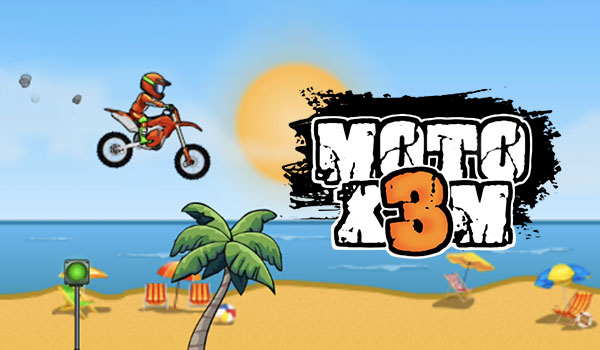
Moto X3M is an off-road motocross racing game that turns level completion into a performance challenge. Developed by MadPuffers and released in 2015, it puts you on a motorcycle across 22 tracks of escalating difficulty — tracks filled with spike wheels, tanks, ramps, and hazards that would make a stunt rider think twice. Your goal isn't just to reach the finish line; it's to reach it as fast as possible and earn the three stars that signal genuine mastery of each level.
The star system is what sets Moto X3M apart from straightforward obstacle courses. Every level has a time threshold for three-star completion, and meeting it often demands more than cautious, careful navigation. The game actively rewards risky aerial play: front flips and backflips performed in the air reduce your total time, meaning that the counterintuitive approach — going faster and committing to stunts rather than playing it safe — is frequently the optimal one. Landing a flip that shaves seconds off your time feels genuinely earned, and the three-star threshold ensures there's always a higher level of performance to chase even on levels you've already cleared.
The obstacles are imaginative and varied: massive spike wheels that rotate into your path, tanks that fire projectiles, explosive barrels, seesaws, pendulums, and ramps that launch you into positions where landing angle is everything. The motorcycle's realistic throttle sounds and physics-based flight and landing behaviour make the game feel tangible in a way that abstract physics games often don't — you feel the bike's weight on takeoff and the consequence of a bad landing in the controls. With stars funding new motorcycle and character skin unlocks, and checkpoint systems keeping frustration low, Moto X3M is a level-based racer with both the challenge ceiling and the reward depth to keep players engaged across its full 22-level roster.
Key Details:
| Field | Info |
|---|---|
| Genre | Motocross Racing / Skill Platformer |
| Difficulty Level | Variable (Easy to Very Hard across 22 levels) |
| Average Play Time | 5–20 minutes per session |
| Best For | Racing fans, stunt game enthusiasts, time-trial and three-star completionists |
How to Play Moto X3M?
Getting Started:
- Select a level from the track menu — start with Level 1 to learn the physics before obstacles escalate.
- Press and hold the Up Arrow to accelerate the bike forward.
- Use the Left and Right Arrow keys to balance and tilt the bike during airborne sections.
- Press the Down Arrow to brake when approaching hazardous landings or tight sections.
- Perform flips in the air by tilting the bike during flight — completed flips reduce your total level time.
Basic Controls:
| Key | Action |
|---|---|
↑ Up Arrow | Accelerate |
↓ Down Arrow | Brake |
← Left Arrow | Tilt bike left (balance / flip) |
→ Right Arrow | Tilt bike right (balance / flip) |
Space | Continue after crash / checkpoint restart |
Objective: Complete each of the 22 levels by reaching the finish line as fast as possible. Earn one to three stars on each level based on completion time — the faster the finish, the more stars awarded. Perform aerial flips to reduce your time and achieve three-star ratings on demanding levels. Accumulate stars to unlock new motorcycle and character skins. Avoid crashing — hitting obstacles with the rider's head restarts from the last checkpoint.
Moto X3M Features & Highlights
✓ Time-based three-star rating system — Complete each level within increasingly tight time thresholds to earn one, two, or three stars — a performance benchmark that challenges players to improve beyond simple completion.
✓ Aerial flip time reduction — Front flips and backflips performed during airborne sections reduce your total level time, making aggressive, stunt-forward play the optimal strategy on many tracks.
✓ 22 levels of escalating difficulty — A structured 22-level roster that progresses from accessible introductions to obstacle configurations that require near-perfect driving and stunt execution.
✓ Checkpoint system — Checkpoints throughout each level allow restart from the most recent progress point after a crash, keeping frustration low without removing consequence from mistakes.
✓ Motorcycle and character skin unlocks — Stars accumulated across all levels fund cosmetic unlocks that customise the bike and rider's appearance.
Moto X3M Tips & Strategies
Beginner Tips:
- Brake before landing on steep downhill ramps. The most common early-level crash is arriving at a downhill ramp at full throttle and flipping the bike on impact. Ease off the accelerator before each ramp and apply the brake briefly mid-air to level the bike's angle before touchdown.
- Use left and right tilt to stabilise landings, not just to perform flips. The tilt keys are more important for basic survival than for stunts. Every time the bike is airborne, use Left/Right to angle it for a clean, flat landing rather than arriving nose-down or tail-first.
- Reach the checkpoint before attempting time-optimising stunts. New players who attempt flips before securing the checkpoint risk crashing and losing the progress that flips were meant to save. Prioritise safe checkpoint reaches on first attempts of each level, then optimise for time on subsequent runs.
Advanced Strategies:
- Identify flip opportunities on every airborne section of each level. Flips are not just stylistic — they are the primary time-reduction mechanism for three-star completion. On any ramp that provides sufficient airtime, determine whether a full flip is achievable before landing and build it into your standard route through the level.
- Use brake-and-accelerate sequences to control trajectory on explosive obstacles. Barrel and explosive sections reward careful momentum management. Approaching slowly enough that the blast launches the bike at a controllable angle, then immediately throttling through the recovery, produces faster and safer results than full-throttle approaches that create uncontrollable trajectories.
- On spike and pendulum sections, time your entry to the obstacle's cycle. Spike wheels and pendulums operate on fixed cycles. Observe one full cycle before committing to a pass-through — the safe window is consistent and repeatable, making these sections about patience and timing rather than pure speed.
What to Watch Out For:
- Head contact with any obstacle ends the attempt at the current checkpoint. The game's collision system is head-specific — the bike can make surface contact on wheels and frame without consequence, but the rider's head hitting any obstacle restarts from the last checkpoint. During complex obstacle sections, prioritise head clearance above all other navigational concerns.
- Losing bike control after a flip that doesn't complete fully. An incomplete flip — one that runs out of airtime before returning the bike to upright — lands the bike at an angle that almost always causes a crash. Only attempt flips when the ramp provides sufficient airtime to complete the rotation fully. Partial flips are worse than no flip at all.
Moto X3M Elements Explained
Three-Star Time Rating System
The three-star time rating system is Moto X3M's central performance mechanic and the feature that transforms level completion from a binary success into a spectrum of achievement. Each of the 22 levels has three time thresholds corresponding to one, two, and three star awards — with three stars requiring the fastest completion time and demanding near-perfect execution of the level's optimal route.
The system creates a natural replay loop that extends the game's longevity well beyond initial completion. A player who finishes Level 12 with one star has technically advanced the campaign but knows exactly how far their performance is from the level's maximum reward. The gap between one-star and three-star completion times on later levels can be substantial, requiring not just obstacle avoidance but active time reduction through flip bonuses and optimal route selection.
Three-star requirements also implicitly teach the game's advanced mechanics. On many levels, achieving three stars without performing aerial flips is mathematically impossible — the time reduction flips provide is necessary to reach the threshold. This makes the three-star system an indirect tutorial for the flip mechanic: players who want the maximum rating on every level are naturally directed toward learning and executing stunts as a core part of their play style rather than treating them as optional extras.
Aerial Flip & Time Reduction System
The aerial flip system is Moto X3M's most distinctive mechanical addition to the motocross racing formula and the feature that most rewards experienced, confident play. When the bike is airborne — launched by a ramp, explosive, or elevated surface — tilting it with the Left or Right Arrow keys initiates a rotation. Completing a full 360-degree flip before landing reduces the total level time by a fixed amount, which accumulates across multiple flips within a single run.
This system inverts the usual risk-reward calculation of racing games. In most racing games, cautious play produces the best times by avoiding crashes. In Moto X3M, cautious play on ramp sections specifically — choosing not to flip when the opportunity exists — results in slower times and lower star ratings. Aggressive, stunt-forward play that uses every ramp for a flip attempt produces consistently better times, provided the flips are completed cleanly.
The risk of the system is the incomplete flip: a flip that runs out of airtime before the bike returns to upright position, landing at an angle that causes a crash and restarts from the checkpoint. Managing this risk — identifying which ramps provide enough airtime for a full flip and which don't — is the primary skill the flip system develops, and it's what separates players who three-star the full roster from those who achieve it only on selected levels.
Obstacle & Checkpoint System
Moto X3M's obstacle design is one of the most varied in the motocross genre, progressing from straightforward ramp sequences in early levels to creative hazard combinations involving spike wheels, projectile tanks, explosive barrels, seesaws, pendulums, and moving platforms in the later stages. Each obstacle type requires a distinct approach: spike wheels and pendulums reward timing; explosive barrels reward controlled approach velocity; seesaws reward weight distribution awareness.
The checkpoint system is what makes this escalating obstacle variety accessible rather than punishing. Checkpoints are positioned at regular intervals throughout each level — after successful navigation of major hazard clusters — meaning that a crash restarts the player at the most recent safe position rather than the very beginning of the level. This design allows players to fail repeatedly on a specific difficult section without losing all the progress that preceded it, making persistence through hard obstacles feel genuinely productive rather than exhausting.
The combination of the checkpoint system and the star rating creates an interesting tension: checkpoints reduce the cost of individual mistakes, but the total level time keeps running whether you crash or not. A level that takes many checkpoint restarts can still be completed, but three-star times become effectively unachievable after multiple crashes. Clean, checkpoint-free runs are the path to maximum star ratings, making the checkpoint system a fallback for learning rather than a tool for high-performance play.
Moto X3M Frequently Asked Questions
Q: How do I perform flips and why are they useful? A: When the bike is airborne, hold the Left Arrow to tilt it left (initiating a backflip) or the Right Arrow to tilt it right (initiating a front flip). A complete 360-degree rotation before landing counts as a flip and reduces your total level time by a fixed amount. Flips are useful because many three-star time thresholds require the time reductions they provide — caution-only runs are often not fast enough for maximum star ratings on later levels.
Q: What happens when I crash in Moto X3M? A: If the rider's head contacts an obstacle, the attempt ends at the current checkpoint — the bike and rider reset to the most recently passed checkpoint position, and your time continues from where it was. Falls that don't involve head contact may not trigger a crash. Press Space to continue from the checkpoint after a crash. Note that each checkpoint restart adds to your total level time, so minimising crashes is essential for three-star completion.
Q: How do I unlock new motorcycle and character skins? A: Stars earned from level completions accumulate in your total star count, which unlocks new bike and character skins at specific thresholds. The more stars you've earned across all 22 levels, the more cosmetic options become available. Improving your star rating on levels you've previously completed with one or two stars is the most direct way to increase your total star count without advancing further in the level roster.
Q: Is Moto X3M available on mobile devices? A: Yes — Moto X3M was developed as a web browser game playable on both desktop and mobile devices. On desktop, the arrow keys provide the most precise control for acceleration, braking, and balance. On mobile, touch controls replace the keyboard inputs. For time-sensitive three-star attempts on later levels, desktop keyboard control offers the most reliable input precision for flip execution and landing balance.
Q: The game seems impossible on later levels — is there a trick? A: Later levels require mastery of the flip system and careful obstacle cycle timing rather than faster reflexes alone. For spike wheel and pendulum sections, observe one full movement cycle before attempting to pass through — the safe window is consistent and repeatable. For three-star times, identify every ramp in the level that provides flip airtime and build flips into your standard route. The time reductions from consistent flipping are often the difference between two and three stars on demanding levels.