






























1. Slope Bike Overview
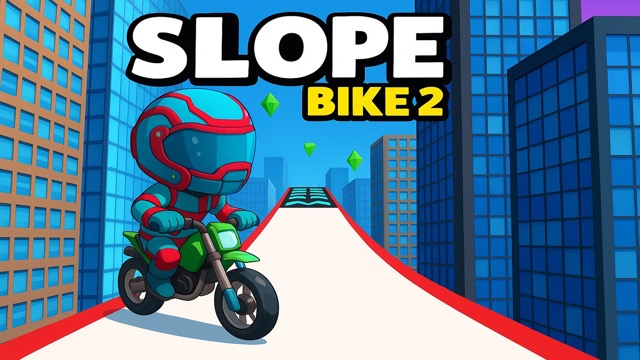
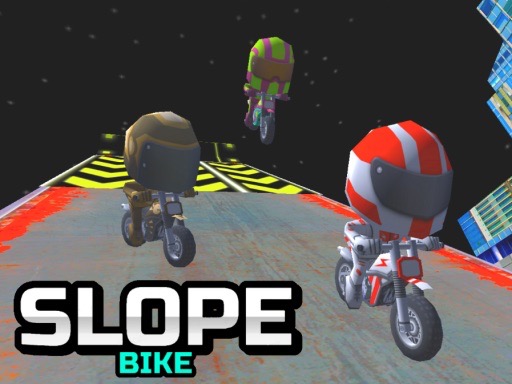
Slope Bike takes the genre's endless runner DNA and mounts it on a motorcycle, sending you through a slope city with a remit that's as simple as it is demanding: go as far as possible while collecting diamonds along the way. The city setting gives the game a grounded, kinetic energy that rolling-ball slope games can't replicate — the bike has weight, the slopes have consequence, and the diamonds scattered across the road aren't just currency but the constant temptation to take the riskier line.
The terrain of the slope city is the game's central challenge. Steep inclines demand that you maintain momentum without losing control. Sharp declines require management of a bike that wants to accelerate faster than you can safely steer. Obstacles litter the road with no guaranteed safe path around them — sometimes the answer is a hard steer, sometimes it's threading between two hazards, and sometimes it's accepting a suboptimal line to avoid a worse outcome. The bike's handling gives you enough responsiveness to make confident decisions but not enough forgiveness to make lazy ones.
Diamond collection adds a layer of strategic risk-taking that pure survival games lack. Some diamonds sit safely in the middle of your natural path; others require a deliberate deviation that puts you in a harder position for the next obstacle. The decision to reach for a diamond cluster in a dangerous section is exactly the kind of judgment call that makes Slope Bike engaging beyond its base difficulty — you're not just surviving, you're constantly assessing whether the reward of a collection is worth the risk of the detour.
Key Details:
| Genre: | Endless Racing / Arcade |
| Difficulty Level: | Medium to Hard |
| Average Play Time: | 5–15 minutes per run |
| Best For: | Players who enjoy vehicle-based slope gameplay; diamond collection and risk-reward decision making |
How to Play Slope Bike?
Getting Started:
- Your bike begins moving through the slope city automatically — steer from the first second.
- Tilt the bike left or right to dodge obstacles and navigate the slope city's terrain.
- Manage speed carefully on both inclines and declines — the bike responds to gradient changes.
- Collect diamonds along the road; they contribute to your score and overall currency balance.
- Survive as long as possible — each collision ends the run immediately.
Basic Controls:
| Action | Input |
| Tilt/Steer Left | Left directional input |
| Tilt/Steer Right | Right directional input |
Objective: Ride as far as possible through the slope city on the motorcycle without colliding with obstacles. Collect diamonds to build your score and currency balance, and make strategic decisions about when the risk of chasing off-path diamonds is worth the reward.
Slope Bike Features & Highlights
✓ Motorcycle handling in a slope setting — the bike's weight and tilt mechanics create a vehicle-based feel that's distinct from rolling ball slope games
✓ Slope city terrain — steep inclines, sharp declines, and urban obstacles create a driving environment that's immediately varied and consistently challenging
✓ Diamond collection as strategic risk-taking — collectibles placed in dangerous positions reward players who assess risk accurately rather than those who play it safe
✓ Dynamic per-level challenge escalation — each level introduces more complex obstacles and terrain than the last, keeping the difficulty curve active across extended play
✓ Endless replay value — no final level; every run is an opportunity to go further, collect more, and refine your approach to the slope city's terrain
Slope Bike Tips & Strategies
Beginner Tips:
- Treat the bike's tilt as a precise tool rather than an on/off switch — the degree of tilt matters, not just the direction. Small tilts for fine corrections, larger tilts only when a full lane change is needed.
- On steep declines, resist the impulse to tilt aggressively — the bike is already accelerating from the gradient, and a large tilt at high speed can carry you into an obstacle before you can correct.
- Evaluate diamonds before committing to them: a diamond in your natural path is free points; a diamond that requires a significant deviation toward an obstacle or edge needs to earn its risk before you steer for it.
Advanced Strategies:
- Develop a read of the slope city's gradient types — steep declines followed by flat sections are speed management challenges; steep inclines after flat sections are momentum management challenges. Knowing which is coming lets you set your speed appropriately before the terrain shifts.
- For diamond clusters in moderately risky positions, plan a route that collects the full cluster in a single smooth arc rather than making multiple small deviations — one controlled detour is safer than three reactive ones.
- At higher levels with increased obstacle density, prioritize survival line over diamond line — a clean path with no diamonds is always more valuable than a diamond-rich path that ends the run early.
What to Watch Out For:
- Obstacle momentum: The bike carries more forward momentum than a rolling ball, which means a collision course that looks avoidable a second ago may not be by the time you reach the obstacle. Begin avoidance maneuvers earlier than instinct suggests.
- Incline-to-decline transitions: The moment the bike crests a hill and begins descending is the highest-risk point of any run. Speed increases rapidly at the crest, and any obstacle placed immediately after the crest has less warning distance than obstacles on flat terrain. Watch for obstacle placement just beyond hill crests.
Slope Bike Elements Explained
Bike Handling and Tilt Mechanics: The motorcycle in Slope Bike steers through tilting — leaning left or right to navigate the slope city's terrain and avoid obstacles. Unlike a rolling ball that responds with neutral physics to directional input, a motorcycle tilt carries a sense of physical commitment — initiating a tilt feels like committing to a direction, and reversing that tilt requires a conscious counter-input. This creates a slightly different skill set from ball-based slope games: the bike rewards deliberate, planned steering rather than continuous small adjustments. Players who develop a feel for the bike's tilt response — knowing how much lean produces how much lateral movement at current speed — will handle the slope city's terrain more consistently than those who rely on reactive inputs.
Slope City Terrain and Obstacle Design: The slope city environment provides Slope Bike with terrain variety that most slope games don't include. Steep inclines require the bike to maintain forward momentum against gravity; lose too much speed and forward progress stalls. Sharp declines add velocity beyond your throttle input; too much speed on a decline and the next obstacle arrives with insufficient time to react. Urban obstacles — the specific hazard types that litter the slope city roads — add the obstacle avoidance layer on top of this terrain management. The combination means Slope Bike players are simultaneously managing speed (gradient response), position (obstacle avoidance), and collection (diamond routing) — a more cognitively demanding parallel-processing task than standard slope games that only require position management.
Diamond Collection and Risk-Reward Economy: Diamonds are Slope Bike's dual-purpose collectible — they contribute to your run score and to a persistent currency balance that funds upgrades or unlocks depending on the game's shop configuration. Their placement on the slope city road is deliberate: some diamonds sit directly on your safe line, requiring no additional risk; others are positioned in locations that require meaningful deviations from the safest path. This range of placements creates a continuous risk-reward assessment throughout each run. The optimal collection strategy isn't "collect every diamond" or "ignore off-path diamonds" — it's a situation-specific judgment call made dozens of times per run based on the diamond's reward, the deviation's risk, and your current position and speed.
Slope Bike Frequently Asked Questions
Q: How do I control the bike in Slope Bike? A: Tilt the bike left or right using the directional inputs to steer through the slope city's terrain and obstacles. The degree of tilt matters — small inputs for corrections, larger inputs for full lane changes.
Q: What should I do when I hit a steep decline? A: Reduce your tilt inputs slightly and prepare for faster obstacle arrival — the bike accelerates on declines beyond your throttle input. Position yourself in the center of the road before the decline begins so you have equal room to maneuver in either direction as speed increases.
Q: Should I always collect diamonds in Slope Bike? A: No — evaluate each diamond cluster based on its position and the surrounding risk. Diamonds directly in your path are always worth taking. Diamonds requiring significant deviation toward obstacles or road edges need a clear safe path to be worth pursuing.
Q: Is Slope Bike available on mobile? A: Slope Bike's tilt-based controls are suited to both desktop and compatible mobile play. The tilting mechanic may translate naturally to physical device tilt on mobile browsers, though control availability varies by platform.
Q: Can I save my diamond balance between sessions? A: Yes — your diamond balance and any unlock progress are stored in your browser between sessions. Clearing browser data or cookies may reset your progress.