























1. Slope Board Overview
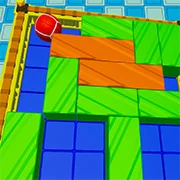
Slope Board is the slope genre's most thoughtful departure from the reflex-driven formula. Instead of steering a ball at high speed through an endless course, you're solving physics puzzles — tilting a board, repositioning wooden blocks, and engineering a path that guides the ball smoothly into its target pocket. It's a game about planning and spatial reasoning rather than reaction time, and it earns its place in the slope family through its clever use of momentum and gravity as the primary tools.
Each level presents a board populated with blocks and a ball that needs to reach a specific goal. You control two variables: the tilt of the board (adjusted with buttons on either side of the screen) and the position of the wooden blocks (dragged along their length to reposition them). These two levers, used in combination, determine how the ball rolls — whether it flows smoothly down a ramp of your construction or gets stuck against a block you didn't move quite far enough.
The special pieces are where Slope Board gets genuinely creative. Triangle blocks redirect the ball at angles; circular pieces let it roll over or around; spring blocks launch it with a burst of momentum that opens otherwise impossible paths. Learning what each piece type does and how to incorporate it into a solution transforms the game from a spatial puzzle into a mechanical engineering challenge. With a timer running on every level and star ratings tied to completion speed, there's always reason to replay a solved level and optimize your solution. Slope Board is the kind of game that rewards patience, experimentation, and the satisfaction of watching a well-designed path work exactly as intended.
Key Details:
| Genre: | Physics Puzzle |
| Difficulty Level: | Variable (increases per level) |
| Average Play Time: | 10–20 minutes per session |
| Best For: | Puzzle enthusiasts, players who enjoy physics-based problem solving, and those who prefer thinking over reflexes |
How to Play Slope Board?
Getting Started:
- Examine the board layout at the start of each level — identify where the ball starts, where the goal pocket is, and what blocks are available.
- Drag wooden blocks along their length to reposition them and create a path for the ball.
- Use the tilt buttons on the left and right sides of the screen to adjust the board's angle.
- Test your setup — release the ball and observe how it rolls. Adjust blocks and tilt based on what happens.
- Guide the ball into the goal pocket before the timer runs out to complete the level and earn stars.
Basic Controls:
| Action | Input |
| Move a block | Drag it along its length |
| Tilt board left | Left tilt button |
| Tilt board right | Right tilt button |
Objective: Roll the ball into the goal pocket by repositioning blocks and adjusting the board's tilt. Complete each level within the time limit to earn the maximum star rating and unlock the next stage.
Slope Board Features & Highlights
✓ Physics-based puzzle design — gravity and momentum are your tools, not obstacles; mastering them is what makes each solution work
✓ Multiple special piece types — triangles, circles, and spring blocks each offer unique ball interactions that open up creative solution paths
✓ Tilt and block control combination — two independent variables to manage creates rich puzzle depth without complicated controls
✓ Star rating system — time-based scoring gives completed levels replay value as you optimize your solutions for a faster clear
✓ Progressive level difficulty — each stage introduces new complexity, ensuring the challenge scales with your developing understanding of the mechanics
Slope Board Tips & Strategies
Beginner Tips:
- Before touching anything, spend a few seconds mapping the full path from ball to goal — identify what's blocking a direct route and what pieces you have to work with.
- Start with the blocks closest to the goal and work backward toward the ball — it's easier to build a path from the destination than from the start.
- Don't tilt the board too steeply — a moderate tilt gives the ball controllable momentum; excessive tilt causes it to skip over blocks and miss the intended path.
Advanced Strategies:
- Use spring blocks early in the path rather than late — placing a spring near the start gives the ball momentum it carries through the rest of the route, reducing the need for steep tilt.
- On timed levels where your solution works but is slow, experiment with increasing the board tilt slightly — more speed means faster completion, as long as the ball still follows the correct path.
- For levels with circular pieces, test using them as redirectors rather than simple rollovers — the ball's angle after interacting with a circle can be leveraged to reach otherwise inaccessible goal positions.
What to Watch Out For:
- Ball getting stuck: If the ball stops rolling mid-path, the tilt is insufficient or a block is positioned too close to another, creating a flat section with no momentum. Increase tilt slightly or widen the gap between the relevant blocks.
- Overshooting the goal: A ball rolling too fast will skip over or past the goal pocket. Reduce board tilt, add a block just before the goal to slow the ball's approach, or use a triangle piece to redirect it into the pocket at a better angle.
Slope Board Elements Explained
Board Tilt System: The tilt mechanic is one of Slope Board's two primary controls and its most nuanced. Tilt determines the ball's baseline speed across the entire board — more tilt means more speed, less tilt means the ball may stall on flat sections. The art of tilt management is finding the angle that keeps the ball rolling continuously without giving it so much speed that it overshoots its path. Tilt also interacts with block placement: the same block arrangement produces different results at different tilt angles, meaning a solution that fails at one angle may succeed with a small adjustment. Experienced players adjust tilt incrementally and observe the result before making further changes.
Block Mechanics: Wooden blocks are the primary path-building elements in Slope Board. They're repositioned by dragging along their length — they can't be rotated or placed freely, only slid within their predefined track. This constraint is intentional: it focuses the puzzle design on the arrangement and spacing of blocks rather than arbitrary placement. Blocks serve multiple functions depending on position: a block in the ball's direct path creates a barrier; a block positioned as a ramp guides the ball in a new direction; two blocks with a narrow gap between them slow the ball as it passes through. Understanding the secondary functions of blocks beyond simple barriers is key to solving more complex levels efficiently.
Special Pieces: Beyond standard wooden blocks, Slope Board introduces three special piece types that dramatically expand what's possible in each level. Triangle pieces redirect the ball at an angle when it makes contact, allowing paths that couldn't be achieved with flat blocks alone — particularly useful for reaching goal pockets positioned at awkward angles. Circular pieces allow the ball to roll over or around them with minimal friction, maintaining momentum through sections where a flat block would slow it too much. Spring blocks launch the ball with a burst of force when triggered, catapulting it over gaps or giving it the momentum to reach elevated goal positions. Mastering all three piece types and understanding how they interact with the ball at different tilt angles is what separates one-star completions from perfect clears.
Slope Board Frequently Asked Questions
Q: How do I move a block in Slope Board? A: Tap and drag the block along its length — blocks can only move in one direction (along their predefined track), so drag in the direction you want it to go. You can't rotate blocks or place them freely.
Q: What should I do if the ball keeps stopping before reaching the goal? A: The ball is losing momentum mid-path. Try increasing the board tilt slightly to give it more speed, or check whether a block is positioned too close to another, creating a flat dead zone. A small gap or angle change is usually all that's needed to restore rolling momentum.
Q: How does the star rating system work? A: Stars are awarded based on how quickly you complete the level. Finishing within a shorter time earns more stars — typically three stars for a fast clear, two for a moderate time, and one for completing the level regardless of time. Replaying completed levels with an optimized solution is the path to three-star ratings.
Q: Is Slope Board available on mobile? A: Yes — the drag and button controls are well suited to touchscreen play. Slope Board is compatible with both desktop and mobile browser play.
Q: What's the best way to use a spring block? A: Position the spring block where the ball will naturally roll into it based on your current path setup. Springs work best when the ball arrives at them with some momentum — a completely stationary ball on a flat board won't trigger the spring effectively. Place springs after a tilted section that delivers the ball with speed, and aim the launch direction toward the next section of your planned path.