















1. Slope Ufo Overview
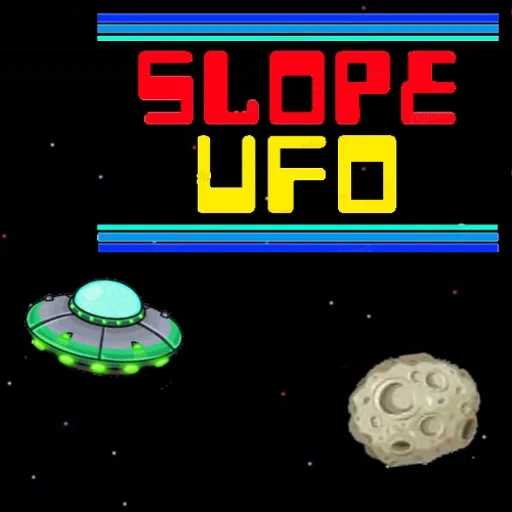
Slope UFO swaps the rolling ball for something far more unpredictable: a flying saucer navigating a tunnel through deep space. You're an alien pilot on a long journey through a star-filled corridor, and your only tool for survival is the ability to make your saucer rise and fall. It sounds simple — and the controls genuinely are — but mastering the saucer's floaty, physics-driven movement is a challenge that takes real time and patience to develop.
The game belongs to the same family as classic "flappy" mechanics, but the space tunnel setting and Slope branding give it a distinct identity. Rocks appear from above and below, the tunnel walls at the top and bottom are instant-death boundaries, and the saucer's response to input is deliberately gradual — hold Space to rise, release to descend, and find the narrow corridor between the hazards. The challenge isn't just reacting to what's in front of you; it's learning how far the saucer travels after you release the button, and anticipating that drift before it becomes a crash.
The space setting is atmospheric and effective. Stars streak past at speed, the tunnel walls press in, and the rocks blocking your path create a constant, rhythmic tension that escalates naturally the longer you survive. There are no power-ups, no unlocks, no secondary objectives — just the saucer, the tunnel, and your ability to keep the two from meeting. Slope UFO is a focused, uncompromising reflex challenge that delivers exactly what it promises and nothing less.
Key Details:
| Genre: | Arcade / Reflex |
| Difficulty Level: | Hard |
| Average Play Time: | 2–8 minutes per run |
| Best For: | Players who enjoy pure reflex challenges and physics-based control mastery |
How to Play Slope Ufo?
Getting Started:
- The saucer begins moving through the space tunnel automatically — be ready to control altitude from the first second.
- Hold the Space bar to make the saucer fly upward.
- Release the Space bar to let the saucer descend naturally.
- Navigate between rocks blocking the tunnel and stay away from the tunnel's top and bottom walls.
- When the saucer hits a rock or a tunnel wall, the run ends — press to restart and try again.
Basic Controls:
| Action | Input |
| Fly Up | Hold Space bar |
| Descend | Release Space bar |
Objective: Survive as long as possible in the space tunnel by steering the flying saucer between rocks and away from the tunnel's top and bottom boundaries. There are no collectibles or finish lines — distance survived is the sole measure of success.
Slope Ufo Features & Highlights
✓ Unique flying saucer control scheme — a rise-and-fall mechanic driven entirely by holding and releasing Space, unlike any standard slope game control
✓ Space tunnel atmosphere — a visually immersive deep-space setting with streaking stars and a tunnel that creates genuine claustrophobic tension
✓ Pure survival challenge — no shops, currencies, or secondary objectives; every run is a clean test of control mastery
✓ Physics-based movement — the saucer's gradual response to input creates a skill ceiling that rewards practice and punishes impatience
✓ Instant restart — failed runs reset immediately, keeping the game's momentum uninterrupted
Slope Ufo Tips & Strategies
Beginner Tips:
- Keep the saucer in the vertical center of the tunnel as your default position — rocks appear most frequently at the top and bottom, so the middle is statistically the safest lane.
- Use short taps on Space rather than long holds early on — the saucer rises faster than beginners expect, and a long hold can carry it into the ceiling before you realize it.
- Don't panic after a near-miss. The instinct to overcorrect after avoiding a rock by a small margin causes more crashes than the original near-miss would have.
Advanced Strategies:
- Develop a feel for the saucer's "float" — the distance it continues rising after you release Space. Anticipating this drift and releasing the key early is the key skill separating average runs from long ones.
- Read rock pairs as a unit, not individually. Rocks typically come in upper-lower pairs with a gap between them — identify the gap's vertical center and aim for it, rather than reacting to each rock separately.
- At higher speeds, shorten your control inputs further. The tunnel passes faster, so the margin for correction shrinks — smaller, more frequent taps replace longer holds.
What to Watch Out For:
- Ceiling creep: The most common death pattern in Slope UFO is gradual upward drift — holding Space slightly longer than needed on repeated upward corrections until the saucer is pressed against the ceiling. Check your altitude relative to the tunnel's center regularly, not just relative to the nearest rock.
- The descent gap: When the saucer is high and needs to drop quickly, releasing Space doesn't produce an instant drop — it descends gradually. If a rock appears low while you're positioned high, you may not have time to descend far enough. Anticipate low-rock sections by dropping early rather than late.
Slope Ufo Elements Explained
Flying Saucer Physics: The saucer's movement is the game's defining mechanic and its primary difficulty source. Unlike a ball that responds to directional input with immediate lateral movement, the saucer moves only vertically — and its response to input is physics-based rather than instant. Holding Space applies a continuous upward force; releasing it allows gravity to pull the saucer downward. The result is a control system with momentum: the saucer continues rising briefly after you release the key, and continues descending briefly after you press it again. Learning to account for this delay — releasing Space before you reach your target height, pressing it before you reach your target low point — is the fundamental skill of Slope UFO and takes consistent practice across multiple sessions to internalize.
Tunnel and Rock Hazards: The space tunnel has two threat types working simultaneously. Rocks appear within the tunnel interior, blocking sections of the path and requiring the saucer to thread through the gap between them. The tunnel walls — the hard boundaries at the top and bottom — are always-present hazards that end a run on contact, even without any rock involvement. This means the saucer is always navigating two danger types at once: the rocks in the middle and the walls at the edges. The safest default position is the tunnel's vertical center, which maximizes clearance from both the top wall and the bottom wall, leaving room to maneuver in either direction when a rock requires it.
Distance and Difficulty Progression: Slope UFO uses a pure distance-based difficulty model. The further the saucer travels, the faster the tunnel moves and the more frequent the rock placements become. There is no level structure or checkpoint system — every run starts from the same point and ends when the saucer hits something. This means improvement in Slope UFO is measured entirely in distance, and the distance record is an honest, unambiguous reflection of how well you've mastered the saucer's physics. Players who approach the game with deliberate practice — focusing on the control mechanic rather than reacting to individual obstacles — improve their records more consistently than those who rely on reflexes alone.
Slope Ufo Frequently Asked Questions
Q: How do I keep the saucer from hitting the ceiling? A: Release the Space bar slightly before the saucer reaches your intended height — the momentum will carry it a little further upward before it begins descending. Over time, you'll develop an instinct for exactly how early to release based on how fast the saucer is rising.
Q: What should I do if I keep crashing into rocks at the bottom of the tunnel? A: You're likely positioned too high when low-gap rock pairs appear, leaving insufficient descent time. Practice staying closer to the tunnel's vertical center — it gives you more room to drop when a low obstacle appears without requiring a fast, large descent.
Q: Is Slope UFO available on mobile? A: Slope UFO uses the Space bar as its sole control input, making it best suited for desktop or laptop browser play. Touchscreen mobile support may be limited.
Q: Can I save my high score between sessions? A: High scores are typically stored in your browser session. Clearing browser data or cookies may reset your recorded distance.
Q: Why does the saucer keep rising after I release the Space bar? A: This is the game's physics-based momentum system — the upward force applied while holding Space doesn't stop instantly when released. This drift is intentional and is the core mechanic you need to master. Releasing the key earlier than you think you need to is the key adjustment most new players need to make.